
End the exception.
Abolish constitutional slavery.
The Abolish Slavery National Network is a national coalition fighting to abolish constitutional slavery and involuntary servitude in all forms, for all people. Slavery is not a metaphor. It is a legal status with a definition the United States already ratified. We measure it. We name it. We enforce its abolition.
Read the definition the United States already accepted.
"Neither slavery nor involuntary servitude, except as a punishment for crime whereof the party shall have been duly convicted, shall exist within the United States, or any place subject to their jurisdiction."
Individuals are no longer allowed to enslave people. For the convicted, the protection was suspended, and the State has treated that opening as permission. That is the exception. That is what we end.
Universal Declaration of Human Rights, Article 4, 1948"No one shall be held in slavery or servitude; slavery and the slave trade shall be prohibited in all their forms."
In all their forms. No exception.
8
States have removed the exception from their constitutions since 2018.
Feb. 13, 2026
Mortis v. Polis. A Colorado court gives a removal its first operational force.
Apr. 17, 2026
New Jersey on notice. The plea disclosure petition is filed and the clock runs.
20+
States, plus Puerto Rico and Washington, D.C., organized in the network.
Join the states that are demanding an end to the exception clause.
Every state constitution answers the exception one of three ways. Some carry no exception, because they removed it or, in Rhode Island, never wrote it. Some carry it. Most say nothing and inherit the federal floor. The territories carry a second layer: a territory may amend its own constitution where it has one, but the federal exception applies there by act of Congress, and only Congress can remove it. Hover or tap a jurisdiction to read its own text.
Select a state or territory
The state's constitutional text, or its silence, appears here.
- No exception in the state constitution. Eight states amended to remove it. Rhode Island never wrote it.
- Organizing to end the exception clause
- Carries the exception or defers to the 13th Amendment
- Territories. The federal exception applies by act of Congress. A local vote cannot remove that layer.
Texts as recorded by the network. Map outline public domain (Wikimedia Commons).
Slavery has a definition. The United States already accepted it.
"Slavery is the status or condition of a person over whom any or all of the powers attaching to the right of ownership are exercised."
1926 Slavery Convention, Article 1(1). The United States acceded in 1929.
That definition is binding United States treaty law. It is not a slogan and it is not an academic construct. The United States bound itself to it by adherence to the 1926 Convention in 1929, and again by accession in 1967 to the 1956 Supplementary Convention that reaffirms it, decades before any scholar glossed it. It is almost certainly not self-executing in United States courts (Medellín v. Texas, 2008): it carries definitional and interpretive weight, not a cause of action. That is why the audits, and not lawsuits, carry it. It names no owner. It measures the powers exercised over a person, whoever exercises them. The State is not exempt.
The powers the definition reaches, as the Bellagio-Harvard Guidelines explain them. The powers and the indicia in full.
- Possession
- Use
- Management
- Profit
- Transfer
- Disposal
Hover or tap a power to see how it is exercised in custody. The powers follow the Bellagio-Harvard Guidelines' gloss on the 1926 definition; the custodial readings are the audits' anchors, not holdings.
- Source text a constitution, statute, treaty, or record, quoted as written
- Established holding what a court has decided, cited to the opinion
- Network position the network's reading, argued and marked as argued
- Audit finding a score from the standards, provisional where it says so
- What the labels mean
"That exception did not preserve a metaphor. It preserved state power."
Dennis Febo, National Lead Organizer
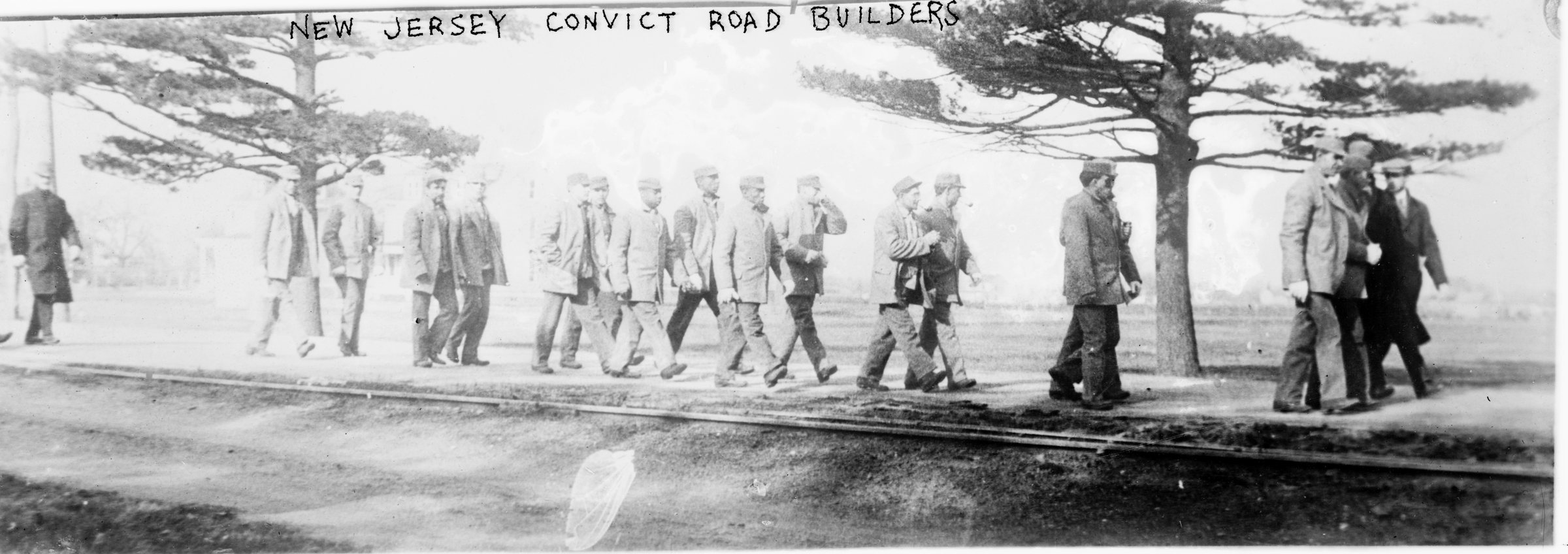
New Jersey convict road builders, about 1910. The exception at work in the network's home state, marched out to build the roads. The clause that authorized it has not changed.
Bain News Service. Library of Congress. No known restrictions.Slavery. Involuntary servitude. Forced labor. Not the same.
The exception hides in the gap between these words. Know which one you are reading, and which one a court is answering.
A status. Ownership. "The status or condition of a person over whom any or all of the powers attaching to the right of ownership are exercised." The 1926 Convention. Not about work; about the powers.
Coerced labor. The domestic term. Labor forced "by the use or threat of physical restraint or physical injury, or by the use or threat of coercion through law or the legal process." Kozminski, 1988. The labor axis.
Labor not offered voluntarily. The international term. Work "exacted from any person under the menace of any penalty" that the person "has not offered himself voluntarily." ILO Convention 29. Work exacted after conviction is excluded only when it is carried out under public supervision and the person is not hired out to private parties (art. 2(2)(c)).
Servitude is the labor axis: what the exception authorizes. Ownership is the status: what the regime only administers as a claim, and what it was never authorized to hold. The exception let the State compel the work. It never made the worker a thing.
The badges and incidents of slavery.
Section 1 abolishes the status. Section 2 lets Congress reach what the status leaves behind: the disabilities that outlive the institution and reproduce it, which the Supreme Court named the "badges and incidents of slavery" in 1883 and confirmed as Congress's to determine in 1968. No court has ever written the catalog. The network measures them, jurisdiction by jurisdiction, on the State's own record, and reports that number beside the prison number without ever adding the two.
What the badges are, how they are measured, and what New Jersey and Minnesota scored.
Congress has the power "rationally to determine what are the badges and the incidents of slavery, and the authority to translate that determination into effective legislation."
Jones v. Alfred H. Mayer Co., 392 U.S. 409, 440 (1968).
What this fight is. What it is not.
Eight states removed the exception. The removals taught the network what a ban has to contain to be enforced. The lessons, in one line each; the argument, in the Twelve Statements.
This fight is
The locked door is not the question. What the State does with the person behind it is.
Colorado struck its exception in 2018 and waited until 2026 for the first order. A bare sentence abolishes nothing a court can enforce.
Alabama and Colorado both pleaded immunity against their own amendments. The waiver goes in the constitution.
This fight is not
Pay is not a defense. Compensation, in any amount, does not make labor voluntary.
California's Proposition 6 went to the voters under that title in 2024 and lost. Nobody compares themselves to being owned.
A statute can be repealed in the next budget. Only an amendment reaches the clause.
From amendment to enforcement.
A ban on paper becomes a ban in practice through records: audits, filings, petitions, and rulings. Five lines of attack, each building its own record.
Plea disclosure
No plea form the network has audited tells the defendant that conviction suspends the protection against slavery. New Jersey's petition, filed April 17, 2026, is the model.
Labor and wage claims
Matched filings with the state labor department and the federal Wage and Hour Division. Two agencies answering the same facts leave a record.
Juvenile waivers
Children transferred to adult court inherit the adult status on conviction. The transfer statutes are the target.
Disabled defendants
Where the law already limits what punishment may reach, the exception's reach is limited too.
The remaining ownership powers
Every power the audit finds exercised is a grassroots trigger. Not every fight is in a courtroom.
Enforcement in full How the audits work The New Jersey record
Mortis v. Polis, Denver District Court, February 13, 2026. The Colorado Department of Corrections' coercive labor practices held unconstitutional under the state constitution as the voters amended it in 2018. The first ruling to give a post-abolition text operational force.
Removed, never had it, or silent: at state law all three collapse into one architecture. There is no exception to enforce against, only the practice.
One book names the claim. The other measures it.
Two instruments by the network's National Lead Organizer. The treatise is coming soon; the standards are circulating. The treatise establishes that the exception has been administered as a claim of ownership. The standards measure that claim, jurisdiction by jurisdiction.
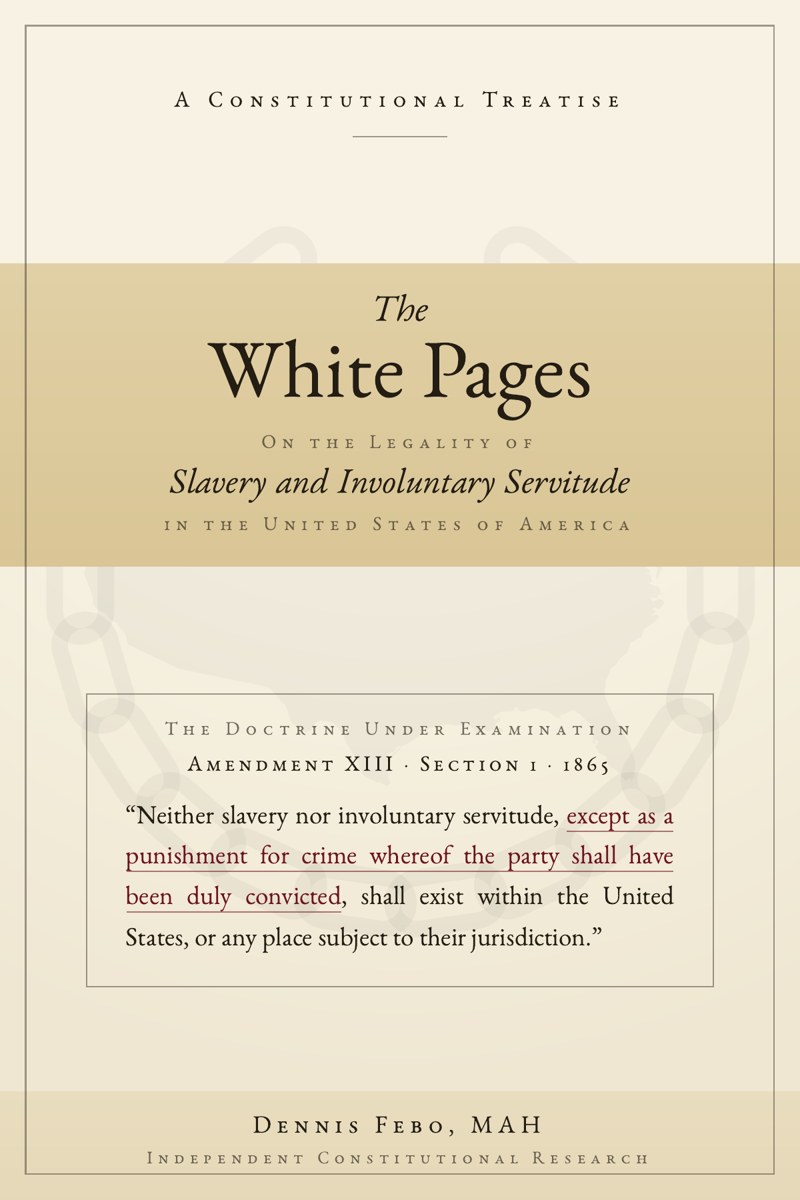
The White Pages
A constitutional treatise. Coming soon: currently in development and review
On the Legality of Slavery and Involuntary Servitude in the United States of America. Dennis Febo. Slavery as a legal structure, not a historical metaphor: the clause, the texts that carry it, the cases that construed it, and the custodial rules administered under it. Every quotation verified against the read opinion.
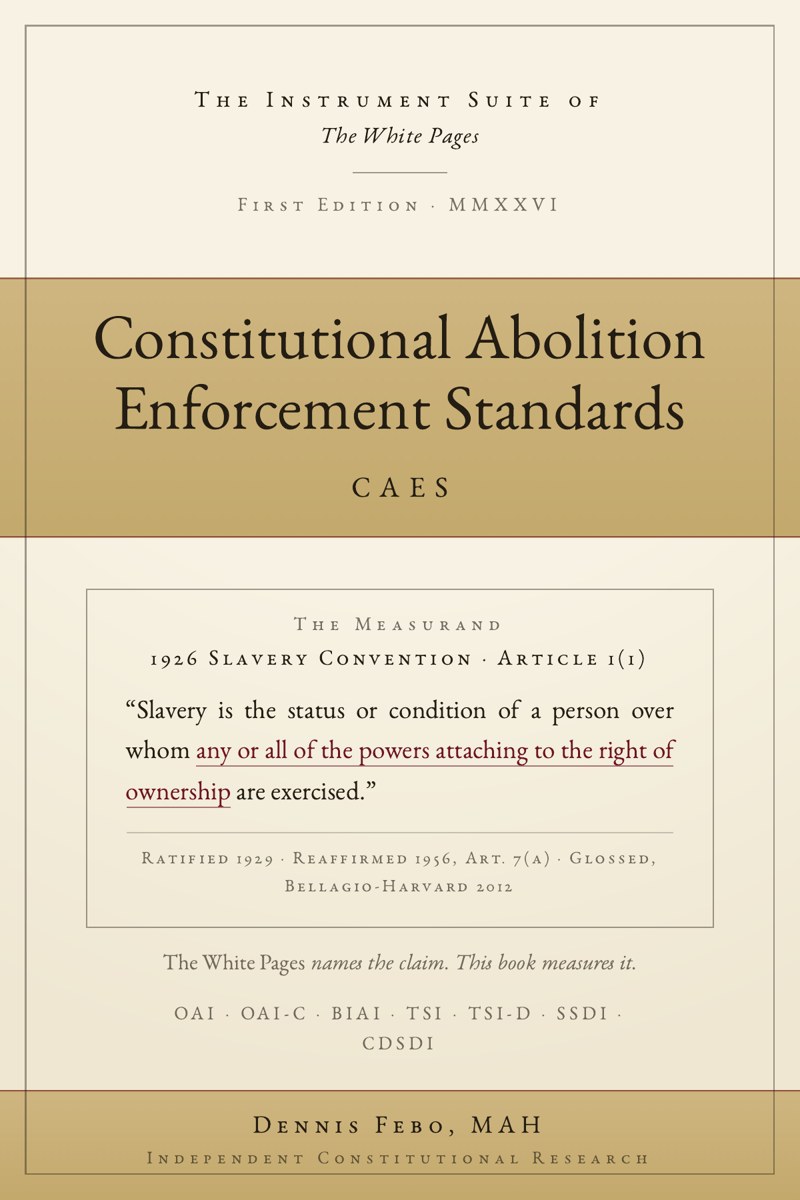
Constitutional Abolition Enforcement Standards
The instrument suite of The White Pages. First Circulating Edition, 2026
Seven instruments that measure the ownership-powers status against the ratified definition, each reported on its own axis and never blended into one number. A score of 1 in any domain triggers grassroots action; 2 or above, a litigation referral.
Both works are the personally held intellectual property of their author, Dennis Febo, licensed to ASNN Foundation Inc. and the ASNN Action Committee. No entity holds title. Publications.
One hundred years of the definition. Ten years of the ballot.
The Slavery Convention, signed at Geneva on September 25, 1926.
The first treaty to define slavery in law: "the status or condition of a person over whom any or all of the powers attaching to the right of ownership are exercised." The United States adhered to it in 1929, and acceded in 1967 to the 1956 Supplementary Convention that reaffirms it. A century on, that sentence is still the measuring rod, and it is the one the network works from. The centennial page: the text, the dates, and the work.
The first ballot, Colorado, November 2016.
Amendment T asked Colorado voters, for the first time anywhere, to strike the punishment exception from a state constitution. It fell short by a fraction. Two years later Amendment A passed, and the removals began: eight states in six years, and eighteen more organized for the coming sessions. A decade of abolition by ballot.
What has been won. What is running.
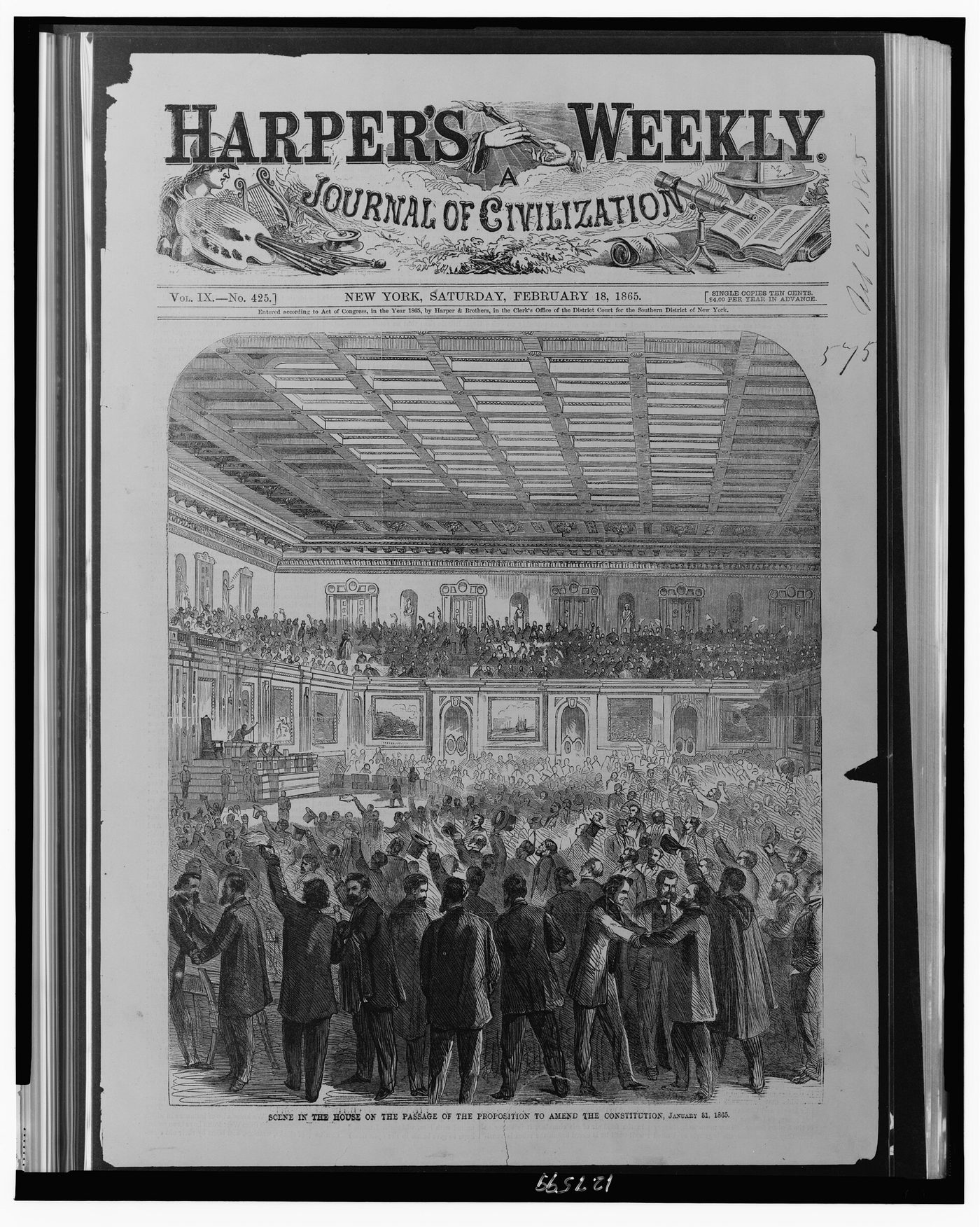
The Slavery Convention is signed at Geneva. Slavery is defined in law as a status. The United States binds itself in 1929.
Eight states remove the exception by ballot, Colorado first: Colorado, Nebraska, Utah, Alabama, Oregon, Tennessee, Vermont, Nevada. California's Proposition 6 fails in 2024 under a forced-labor title.
Mortis v. Polis. A Denver court holds Colorado's coercive prison labor unconstitutional under the amended state constitution. The validating ruling.
The plea disclosure petition is filed with the New Jersey Supreme Court Criminal Practice Committee. New Jersey is on notice.
The Puerto Rico campaign opens at Casa Sofía on el Día de la Abolición de la Esclavitud. In June the network's scorecard goes to the United Nations Special Committee on Decolonization as Petitioner No. 230.
H.J. Res. 216 and S.J. Res. 214, the federal Abolition Amendment, are introduced in the 119th Congress with 54 House cosponsors and thirteen Senators.
Eighteen states are organized to move removal in the coming sessions. What is built in New Jersey is built for every state after it.
Every event and hearing Every jurisdiction How it was reported The research library
Bring your state in.
State coalitions are members of the network. They carry their own voice and their own positions. The network carries the definition, the instruments, and the record across jurisdictions.
Organizers, legislators, and attorneys get the same record for their state, written for each. If your state still carries the exception, or removed it and has not enforced it, write to us.
Member coalition: The Coalition to End Slavery NJ, Camden, New Jersey.