
A national coalition. One mission.
The Abolish Slavery National Network is a national coalition fighting to abolish constitutional slavery and involuntary servitude in all forms, for all people. It builds the legal record, the measurement framework, and the enforcement architecture that turn a ban on paper into a ban in practice.
From amendment to enforcement.
A removal is the beginning of enforcement. The network designs the enforcement before the vote and carries the record after it.
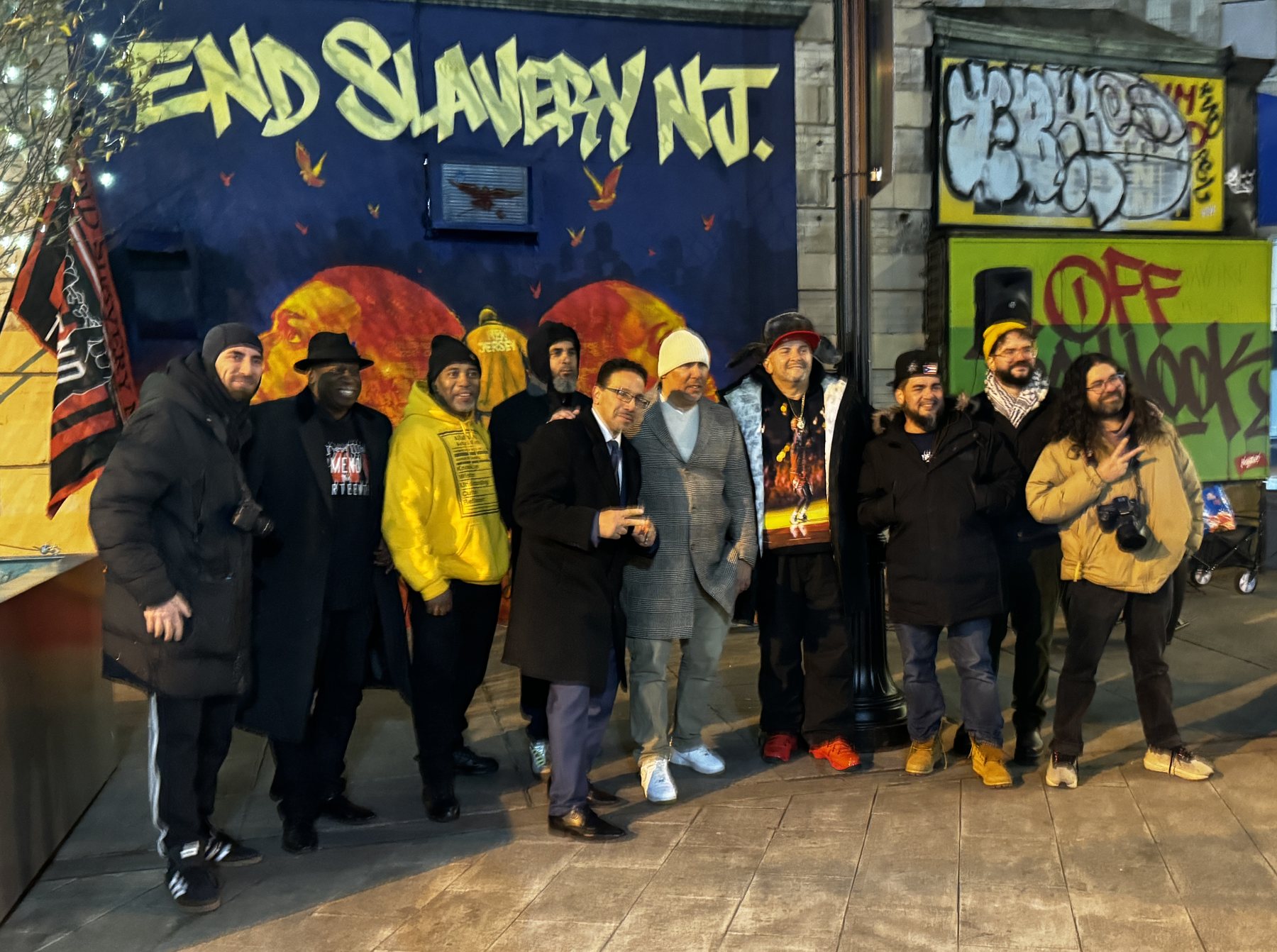
The dedication of End Slavery NJ, Jersey City, December 6, 2024. The network, the coalition, the artist, and the people who showed up in the cold.
Photograph: ASNN. Mural by MUST ART with Mural Arts Philadelphia and Worth Rises.Two entities. Many state coalitions.
The network operates through two entities. ASNN Foundation Inc. is a 501(c)(3) organization. It carries the research, the education, and the audit program. The ASNN Action Committee is its 501(c)(4) affiliate. It carries the legislative and campaign work.
State coalitions are members of the network. They carry their own voice and their own positions, backed by the network's definition, instruments, and record. The Coalition to End Slavery NJ is the anchor coalition and the model for the states after it.
Since its founding the network has grown to more than twenty states, Puerto Rico, and Washington, D.C.
The White Pages on the Legality of Slavery and Involuntary Servitude in the United States of America, a constitutional treatise, and the Constitutional Abolition Enforcement Standards, its instrument suite. Both are the work of Dennis Febo and are licensed to the network. About the books.
Who leads the work.
Kamau Allen
President of the Abolish Slavery National Network.
Dennis Febo
National Lead Organizer of the Abolish Slavery National Network. Author of The White Pages and the Constitutional Abolition Enforcement Standards. Independent constitutional researcher.
Isabel Kennon
Board Secretary of the Abolish Slavery National Network.
Slavery is a legal status.
The network works from the definition the United States ratified: "the status or condition of a person over whom any or all of the powers attaching to the right of ownership are exercised." 1926 Slavery Convention, Article 1(1), reaffirmed by the 1956 Supplementary Convention, Article 7(a), and explained by the Bellagio-Harvard Guidelines of 2012. The treaty is the authority. The Guidelines interpret it.
That definition names no owner. It measures the powers exercised over a person, whoever exercises them. The State is not exempt. Read the definition.
Bring your state in.
If your state still carries the exception, or removed it and has not enforced it, write to us.
Four kinds of sentence, labeled.
Every proposition on this site is one of four things, and the label beside a section says which. The discipline is the same one the network's vault imposes on itself: a reader should always know whether they are looking at a text, a court, the network, or an audit.
Source text
A constitution, statute, treaty, regulation, or record, quoted as written. The 1926 definition, the Thirteenth Amendment, a state's clause, a plea form.
Established holding
What a court has decided, cited to the opinion. Jones v. Mayer on the badges. Kunarac on the indicia. Mortis v. Polis on the Colorado amendment.
Network position
The network's reading, argued and marked as argued: the status frame, the three terms, the enforcement posture, the gate on the badges. You can disagree with it. You can see exactly what it is.
Audit finding
A score from the standards, read from a jurisdiction's own written rules. An audit classification about exercised powers, never a holding, and provisional where it says so.
The easiest way to dismiss this work is to say it mixes advocacy with law. The labels make that impossible. Where the site quotes, it says so. Where it argues, it says so. Where it measures, it says what the measure is and is not.