
The Constitutional Abolition Enforcement Standards
Measure it. Then constrain it. CAES is a measurement system. It answers one question, put to a jurisdiction: is the punishment exception being administered as a claim of ownership over the convicted person, and how far. This page is the instruments in plain terms.
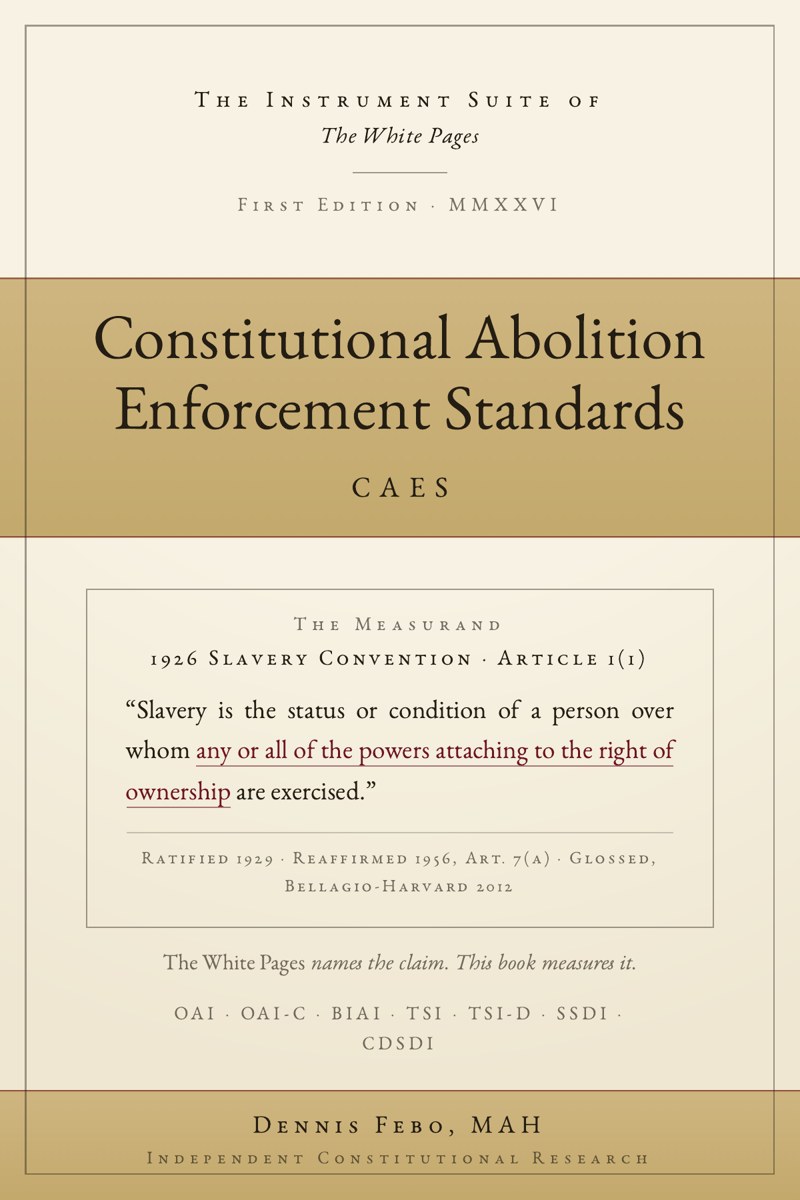
Slavery is a legal status, not a labor condition. The exception suspends the protection against it. Suspension is not a grant. What a regime exercises in the opening is exercised, never authorized.
CAES measures whether the powers of ownership are exercised, on which object, by which sovereign.
Ask what bears the wrong. The answer selects the instrument.
Ownership Audit Instrument
The person in custody after conviction. The core of the suite. Seven domains: movement; labor and services; bodily autonomy; time; living conditions; communication; discipline and force. Each scored 0 to 3 against fixed anchors, read from the jurisdiction's own statutes and regulations, never from anecdote.
Civil Detention Variant
The person in custody without a conviction: immigration detention, civil commitment. The exception cannot apply at all, because there is no conviction, so every exercised power stands unshielded. The sharpest case, not a softer one.
Badges and Incidents Audit Instrument
The structural residue of the abolished status, borne by a whole population. It scores the present conditions that reproduce the burdens the institution left, and builds the record a legislative determination would rest on. The measure is status, never race. Where a state reports its own racial counts, they enter as the state's admission against itself.
Territorial Subordination Instrument
A subordinated territory: the powers one government holds over a subordinated people, and the security of that holding. Puerto Rico, Guam, the Virgin Islands, American Samoa, the Northern Marianas.
Territorial Subordination Instrument, Domestic Variant
A subordinated Indigenous nation, established by political continuity, not by federal recognition.
Is anyone told?
Slavery Status Disclosure Indicator
Audits one thing: whether a person pleading guilty is ever told that conviction suspends the constitutional protection against slavery and involuntary servitude for the sentence's term. Three states: DISCLOSED, ABSENT, UNAUDITED. It is never a number and never adjusts one. Once a jurisdiction is put on notice, a clock runs. Delay after notice is an aggravating factor, never a grace period.
Civil Detention Status Disclosure Indicator
The counterpart for civil detention.
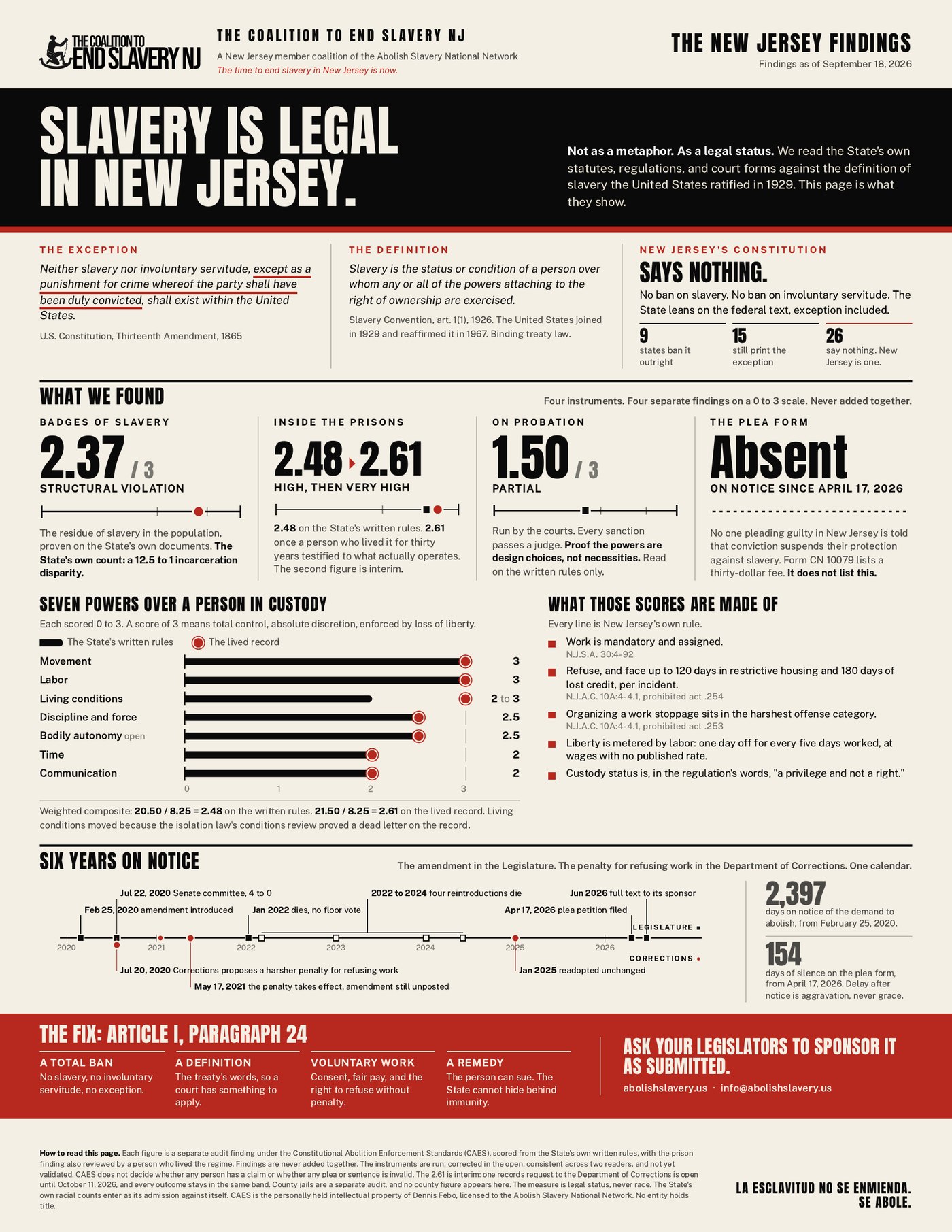
ABSENT. On notice since April 17, 2026. No one pleading guilty in New Jersey is told. Plea Form CN 10079 lists a thirty-dollar fee. It does not list this. The New Jersey record.
Domains, anchors, weights, bands.
Each domain is scored 0 to 3 against fixed anchors. A 3 means total control, absolute discretion, enforced through loss of liberty, and all three must hold together. Each domain carries a weight, so the load-bearing powers count for more, and the weighted scores compose into one index for that instrument, read against shared bands.
One gate stands before the scoring: security of holding, the holder's protection against losing the person held, which the custodial regime acquires at the judgment of conviction. A gate is a threshold, not a domain. It decides whether you score at all.
Numbers never cross instruments. A jurisdiction's result is a panel of separate findings, never one blended figure.
One object, one instrument. Every fact scores on exactly one instrument, chosen by the object that bears the wrong.
Status, not race. The gate is race-neutral. Race enters afterward, as the state's own count, as evidence.
Wired to action. A domain score of 1 is the trigger for grassroots organizing. A score of 2 or above activates a litigation referral.
New Jersey, on the State's own rules.
The first jurisdiction fully scored under the standards. Four findings, each on its own axis, never added together. Findings frozen as of September 18, 2026. The full record. The scorecard one-pager (PDF).
A score of 1 in any domain triggers grassroots organizing. A score of 2 or above triggers a litigation referral. The bar is the written rules; the gold line is the lived record where it differs.
Weighted composite 2.48 on the written rules, 2.61 on the lived record. A 3 means total control, absolute discretion, enforced by loss of liberty, and all three must hold together.
Download the PDFThe full New Jersey record
The same findings are in the charts above and in the table below, for readers who use a screen reader.
Read the panel as a table
| Finding | Written rules | Lived record | Band |
|---|---|---|---|
| Badges of slavery (BIAI) | 2.37 | Structural violation | |
| Inside the prisons (OAI) | 2.48 | 2.61 | High, then very high (interim) |
| On probation (OAI) | 1.50 | Partial | |
| The plea form (SSDI) | ABSENT. On notice since April 17, 2026. | ||
| Domain | Written rules | Lived record | |
| Movement | 3 | ||
| Labor and services | 3 | ||
| Living conditions | 2 | 3 | |
| Discipline and force | 2.5 | ||
| Bodily autonomy | 2.5 | Open | |
| Time | 2 | ||
| Communication | 2 | ||
Minnesota, on the State's own rules.
A free state that never governed slavery, where every axis fires. Three findings, each on its own axis, never added together. The custody figure was ruled July 27, 2026 after a sealed draft and a blind second read; the nation figures are ceilings that wait on the nations themselves. What is still pending is stated as pending.
Article I, Section 2 of the Minnesota Constitution still carries the exception. Repeal bills have died in committee. A score of 2 or above triggers a litigation referral.
Weighted composite 2.55, Very High, on the written rules of the Department of Corrections. Provisional until a lived record tests the checks the run credited. The spine of the finding is the coupling of discipline, time, and labor: refusing work becomes prison time.
A state is never scored on this axis; each nation is. The Family domain is unscored until each nation is consulted, because a nation interprets its own institutions. The figures are ceilings and will be re-run blind when the consultations return.
The plea-form disclosure audit. The lived-record pass that would test the custody run's credited checks. The four nation consultations, which are relationships and not retrievals. The blinded re-run of the nation figures those consultations unlock. Three badges rows held conservative until Minnesota-specific courtroom, civic, and generational data are in.
The Minnesota chapter of the demonstration volume carries the full record. Sources.
Read the panel as a table
| Finding | Score | Band | Status |
|---|---|---|---|
| Badges of slavery (BIAI) | 2.37 | Structural violation | Confirmed; three rows conservative |
| Inside the prisons (OAI) | 2.55 | Very high | Ruled July 27, 2026; provisional against lived record |
| Red Lake (TSI-D) | 1.20 | Ceiling, consultation-gated | |
| Menominee (TSI-D) | 1.53 | Ceiling, consultation-gated | |
| White Earth (TSI-D) | 2.13 | Ceiling, consultation-gated | |
| Lower Sioux (TSI-D) | 2.47 | Ceiling, consultation-gated | |
| The plea form (SSDI) | Not yet audited. | ||
| Domain (OAI) | Written rules | ||
| Movement | 3 | ||
| Labor and services | 3 | ||
| Living conditions | 3 | ||
| Discipline and force | 2.5 | ||
| Bodily autonomy | 2 | ||
| Time | 2 | ||
| Communication | 2 | ||
Three disavowals.
Its scores are not holdings. Every score is an audit classification about exercised powers, not a determination of legal ownership. No finding invalidates any conviction, plea, or sentence.
Its numbers move only on documented, primary-source evidence. Where a run has overstated, the correction is logged in the open. That is the instrument working.
It exists because a claim of ownership has been administered against convicted persons for a century, and that claim has never been adjudicated, measured, or constrained. The measure is the precondition of the constraint.
CAES is the personally held intellectual property of its author, Dennis Febo, licensed to the network. No entity holds title.
Cite this page. Abolish Slavery National Network, “CAES: Constitutional Abolition Enforcement Standards,” https://abolishslavery.us/instruments.html.