
The model amendment.
The amendment the network has drafted for every state. The language is up front, part by part, with one plain paragraph under each saying what it does. Each state fills in the names in brackets: its section number, its trial court, and its immunity statutes.
Slavery and involuntary servitude are prohibited. This prohibition applies in all circumstances, including as punishment for crime, and admits of no exception.
Model text, November 2026. Each state's coalition adapts the bracketed names and carries the campaign.
Make illegal what is illegal, with accountability and recourse.
True abolition is “the ability to make illegal what is illegal, with accountability and recourse.” Dennis Febo.
Six pillars hold this amendment up. Every part of the text carries at least one of them.
- The status is the wrong. Slavery is a legal status: a person over whom the powers of an owner are exercised. Work is evidence of the status. It is never the wrong itself. Carried by (a) and (e).
- No exception, anywhere. Make illegal what is already illegal. In 1929 the United States undertook to bring about the complete abolition of slavery in all its forms. The punishment exception in the federal Thirteenth Amendment suspends the federal protection for a person convicted of a crime. A suspension grants no one the powers of an owner. This amendment gives a state its own ban, with no exception. Carried by the opening sentence.
- Possession is the gate; the powers are the measure. Confinement is possession. Possession alone is not slavery. Once the gate is met, a court must measure which powers of an owner were exercised over the person. Carried by (a).
- The State answers. No immunity of any kind bars the case, and the State gets no deference when it claims the work was chosen. Carried by (f) and (c).
- A remedy only the status can earn. A person held in slavery is owed a judgment declaring it, binding on the State, and damages for the status itself. The damages are never nominal. Carried by (e).
- Free work survives; forced work ends. A person may choose to work and may stop. Work a person cannot refuse is prohibited, not regulated. Pay is a separate bill. Carried by (c).
What comes after this amendment. Three things follow abolition, each in its own bill: reaching the badges and incidents that follow a person after the status ends; repair for time held under the old exception; and pay, deductions, and safety for work freely chosen. This amendment does not carry them. It is the ground they stand on.
Seven parts. Each with a job.
(a) says what slavery is. (b) says what forced work is. (c) says what a real choice is. (d) ends the headcount guarantee. (e) opens the courthouse. (f) takes away the State's shield. (g) clears the books.
Model text
[Section number.] Slavery and involuntary servitude are prohibited. This prohibition applies in all circumstances, including as punishment for crime, and admits of no exception.
This sentence writes the ban and names the one circumstance the federal Thirteenth Amendment leaves open: punishment for crime. "Admits of no exception" means no court can read one back in, whether from a treaty, a statute, or a purpose.
(a)For purposes of this section, slavery is the status or condition of a person over whom any or all of the powers attaching to the right of ownership are exercised. The exercise of such powers includes: using a person; managing the use of a person; profiting from the use of a person; appropriating the fruits or products of a person's labor; or transferring, disposing of, or degrading a person by treating them as an object of ownership. Any one of these is sufficient to constitute slavery where it is exercised over a person under control tantamount to possession, and confinement is such control. Possession alone is not slavery. Legal title and total dominion over the person are not required. It makes no difference whether a power is exercised for public or private benefit, or whether the labor produces goods for sale or maintains the institution. No proof of intent or motive is required.
Slavery is a status: a person over whom the powers of an owner are exercised. The words are the treaty definition the United States joined in 1929 (1926 Slavery Convention, Art. 1(1); 1956 Supplementary Convention, Art. 7(a)). The list of powers follows the Bellagio-Harvard Guidelines (2012): using a person, managing that use, profiting from it, taking what the person's labor produces, and transferring, disposing of, or degrading a person as an object of ownership. Confinement is the control the definition requires, but confinement alone is not slavery. The State may still hold a person under law. It may not exercise an owner's powers over that person. Nobody has to hold a title, and nobody has to prove intent.
(b)Involuntary servitude is the condition in which a person is compelled to labor or render service by force, threat of force, physical restraint, abuse or threatened abuse of legal process, fraud, deception, or any scheme, plan, or pattern that would cause the person to believe that nonperformance would result in serious harm or restraint of liberty. Serious harm means any harm, whether physical or nonphysical, including psychological, financial, or reputational harm and the deprivation of a basic human need, that is sufficiently serious, under all the circumstances, to compel a reasonable person of the same background and in the same circumstances to perform or continue labor or service to avoid it. The definitions in this section are independent of one another.
This covers the second wrong: being made to work by force, threats, restraint, abuse of legal process, fraud, or any scheme that makes a person believe serious harm will follow if they stop. Serious harm includes psychological, financial, and reputational harm and the loss of a basic need, judged by what would move a reasonable person in the same circumstances. The words follow the federal forced labor statute, not the narrow reading the Supreme Court gave servitude in 1988. Slavery and servitude stand apart. A person need not prove one to win on the other.
(c)Labor or service performed for the State, a subdivision, or any other person or entity by a confined person, or by any person by reason of a charge, conviction, or sentence, that is not voluntary under this subsection is prohibited, and the State, subdivision, person, or entity bears the burden of proving by clear and convincing evidence, without deference, that the labor was voluntary. Labor or service includes any work, task, detail, chore, or program activity, however designated. Labor is voluntary only if the person retains the unimpeded right to refuse or cease it without penalty. A penalty includes any sanction imposed because a person refused or ceased labor, whatever the charge, order, or rule under which it is imposed, and the loss, denial, or delay of any credit, reduction of sentence, or release opportunity conditioned upon labor. Labor that is voluntary under this subsection is not the exercise of a power under subsection (a). No consent, waiver, plea, agreement, or condition of sentence or supervision is a defense under this section.
Work stays. What ends is work a person cannot refuse. Work is voluntary only if the person can refuse or stop without penalty. A penalty is any sanction for refusing, whatever it is called, and the loss of any credit, sentence reduction, or release opportunity that only work can earn. This covers anyone confined, and anyone working because of a charge, a conviction, or a sentence. Whoever receives the work must prove it was voluntary. No plea, waiver, or condition of sentence can sign the right away.
(d)No contract, agreement, or arrangement shall condition any payment, occupancy, or benefit upon the maintenance of a minimum number of confined persons or upon the availability of their labor.
No contract may pay for keeping a minimum number of people confined, or for the availability of their labor. A promise to keep the beds full is how an interest in confinement becomes a line in a contract. This ends it.
(e)This section is self-executing. Any person subjected to a violation of this section may bring a civil action and may obtain injunctive, declaratory, and monetary relief, including damages and reasonable attorney's fees and costs. The action is an original action in [the trial court of general jurisdiction]. No administrative remedy need be exhausted before it is brought, and the availability of review of agency action does not bar or delay it. To be held in slavery is an injury in itself, and a claim under subsection (a) carries its own remedy. A person held in slavery is entitled to a judgment declaring that status, binding on the State, and to compensatory damages for the status itself, without proof of labor, loss, or compulsion. Those damages are measured by the duration of the status and the powers exercised and shall not be nominal. A person held in involuntary servitude is likewise entitled to a judgment declaring that condition and to compensatory damages for it. Because relief under one subsection does not supply the remedy of another, a claim under subsection (a) or (b) is not rendered moot, unnecessary, or subject to discretionary refusal by relief available or awarded under any other subsection, and a person who brings such a claim may obtain a judgment determining it. A judgment under this section is payable without further appropriation. A claim under this section may be brought while the status or condition continues, and the time to bring it does not begin to run until it ends. This remedy is in addition to any other remedy available at law or in equity.
The ban works on its own. No further law is needed to switch it on. Any person subjected to a violation may go to court for an order, a declaration, damages, and attorney's fees, without first going through an agency process. To be held in slavery is an injury in itself. A person held in slavery is owed a judgment declaring it, binding on the State, and damages for the status itself, measured by how long it lasted and which powers were exercised. Those damages are never nominal.
(f)No immunity, including sovereign, qualified, and good-faith immunity, however denominated, shall bar, limit, or delay an action or remedy under this section. No notice requirement, limitation on liability, or restriction on remedies under [the State's tort claims and governmental immunity statutes] or any successor law shall bar, limit, or delay an action or remedy under this section. The State, a subdivision, or an entity is liable for a violation committed by its officers, employees, agents, or contractors, or by any person or entity to which it transfers, contracts, or commits a person in its custody or under its sentence, and this section protects such a person wherever held.
Without this part the ban has no remedy. Alabama struck its exception in 2022, and the first suit was dismissed on sovereign immunity. No immunity of any kind, sovereign, qualified, good-faith, or any other name, may bar, limit, or delay a case under this section, and the State's tort claims rules cannot cut it short. The State answers for its officers, employees, agents, and contractors, and for anyone it sends a person to, wherever that person is held.
(g)Any law, regulation, rule, order, contract, or practice inconsistent with this section, whether adopted before or after this section takes effect, is void to the extent of the conflict.
Any law, rule, order, contract, or practice that conflicts with the ban is void to the extent of the conflict, whether it came before or after. No separate repeal campaign is needed, and no agency can say it is waiting for the legislature.
Using the model. Where the state constitution carries the punishment exception, this section replaces the clause that carries it. Where the constitution is silent, it is added to the bill of rights. Fill the brackets with the state's own names. Change nothing else. Each part has a job.
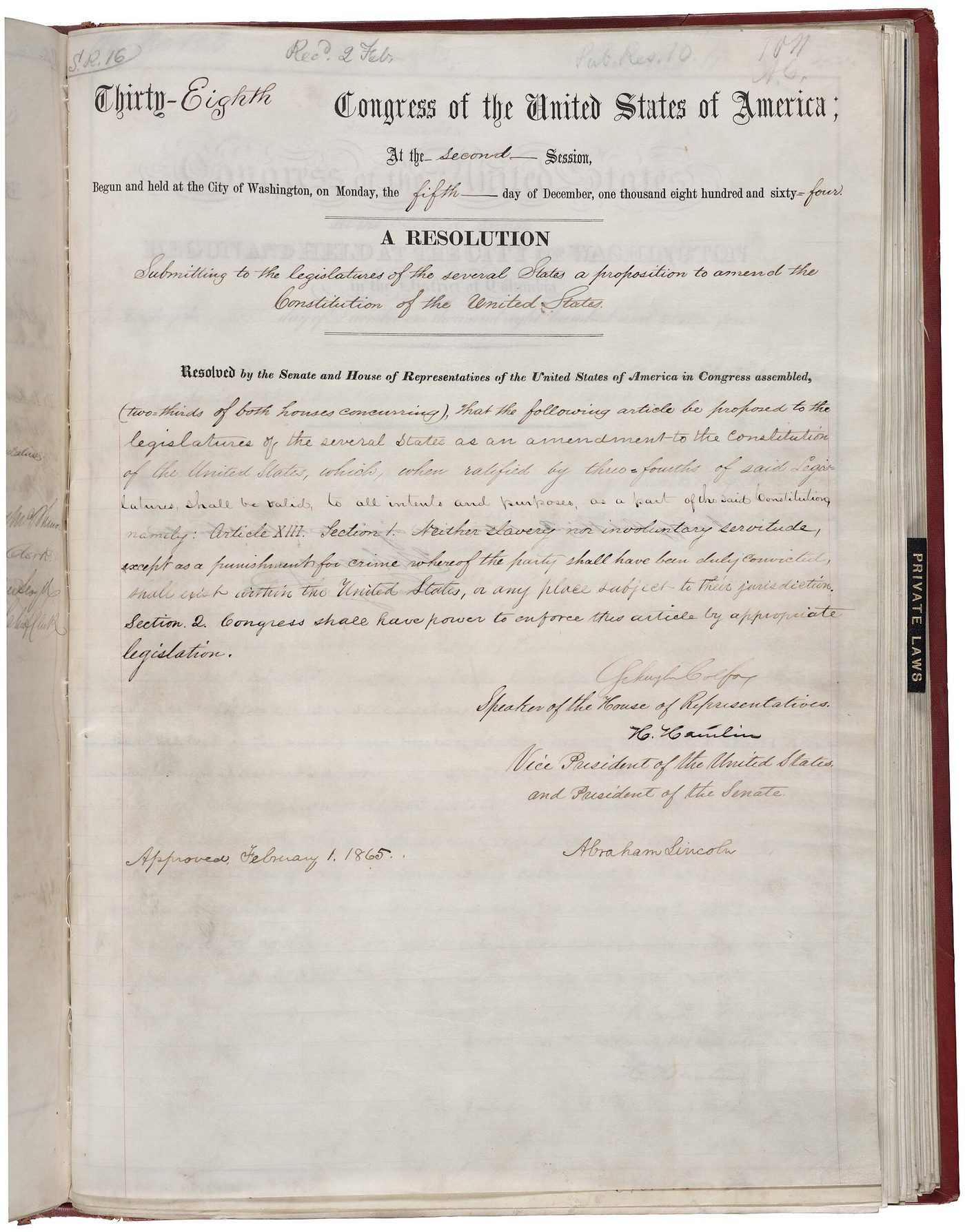
The joint resolution proposing the Thirteenth Amendment, 1865. One sentence, one exception. Every state text on this site descends from it. The model above writes the sentence without the exception.
National Archives. Public domain.The question the voter answers.
Ballot question
Do you approve amending the Constitution to prohibit slavery and involuntary servitude in all circumstances, including as punishment for crime, without exception, so that the State may confine a person but may not exercise the powers of an owner over anyone?
Adds this protection to the Constitution.
Leaves the Constitution unchanged.
It asks about a status. It does not mention work, wages, or prison jobs, so a voter cannot answer it by comparing a confined person's work to their own. The question is whether the State may hold a person as an owner would, and the answer it invites is no.
In 1929 the United States undertook, for every territory under its jurisdiction, to bring about the complete abolition of slavery in all its forms. This amendment keeps that undertaking. It bans slavery and involuntary servitude in [State] in every circumstance, including as punishment for a crime. The amendment defines slavery as the United States has by treaty since 1929: exercising over a person the powers of an owner, whether or not anyone claims to own that person. The State may still confine a person under law. It may not use that person or punish that person for refusing to be used. A person in custody or serving a sentence may still choose to work, including community service, and may stop. A person held in slavery may go to court for a judgment and damages, the State may not claim immunity, and laws and rules that conflict with the ban no longer apply. A "YES" vote adds this protection. A "NO" vote leaves the Constitution unchanged.
Where a state prints a summary beside the question, this is the model. Some states print the whole text on the ballot instead.
What the removal states taught.
The removal states showed what a bare sentence cannot do. Colorado struck its exception in 2018 and won its first court order in 2026, with no damages. Alabama struck its exception in 2022, and the first suit was dismissed on sovereign immunity. So this text carries its definition, so a court has something to apply; its self-executing remedy, so the status is its own injury; and its immunity waiver, in the constitution, where a statute cannot reach it.
It sets no wage and makes no person an employee. Compensation and workplace protections for confined persons are separate legislation, which may govern only labor that is voluntary under (c). Labor that is not voluntary is prohibited, not regulated. The twelve statements carry the authorities.
Ask your legislators to sponsor it as submitted.
Each state's coalition carries its own campaign. To bring the amendment to your state, write to us.