
Slavery is legal in New Jersey. Not as a metaphor.
New Jersey's constitution says nothing about slavery. No ban, no exception, nothing. The State leans on the federal text, exception included. We read the State's own statutes, regulations, and court forms against the definition the United States ratified in 1929. This page is what they show. Findings frozen as of September 18, 2026.
Screen reader users: the petition is a scanned filing. Its substance is set out in text on this page. The one-pager's findings are the panel below and the table on the CAES tab.
ABSENT. On notice since April 17, 2026.
No one pleading guilty in New Jersey is told that conviction suspends their protection against slavery. Form CN 10079 lists a thirty-dollar fee. It does not list this. The petition to fix it, filed April 17, 2026 by the Coalition to End Slavery in New Jersey and the network, is before the Supreme Court's Criminal Practice Committee. Download the filed petition, with the cover letter and the letters of support.
2.37
Badges of slavery, out of 3. Structural violation. The State's own count: a 12.5 to 1 incarceration disparity.
2.48
Inside the prisons, on the State's written rules. 2.61 on the lived record, interim.
1.50
On probation. Partial. Every sanction passes a judge. Proof the powers are design choices.
Absent
The plea form. No disclosure. The clock runs from April 17, 2026.
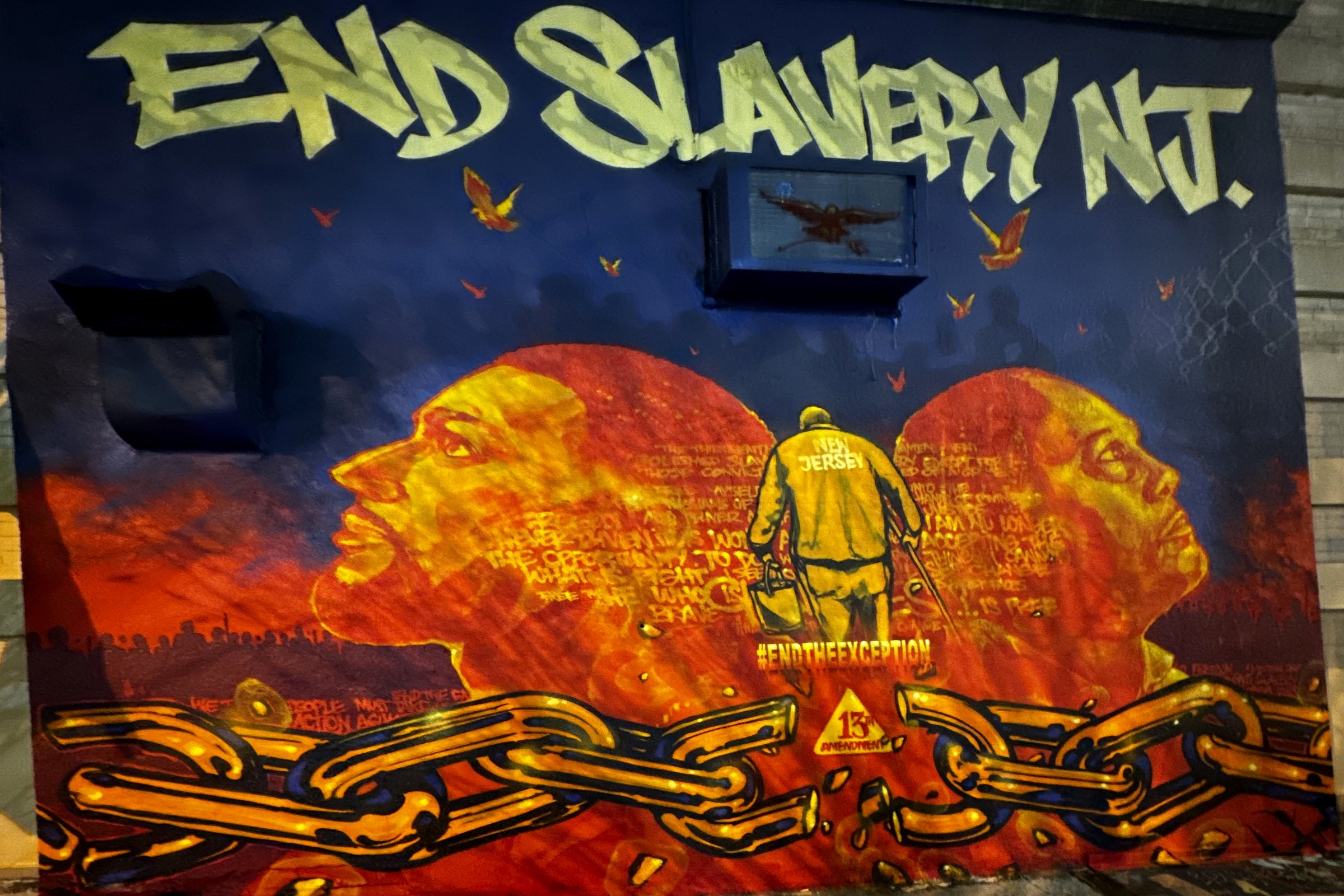
End Slavery NJ. The wall in Jersey City. Two faces, one person in state clothes walking out, and the chain broken at the Thirteenth.
Mural by MUST ART, 2024, with Mural Arts Philadelphia, Worth Rises, End Slavery NJ, and ASNN. Photograph: ASNN.Every line is New Jersey's own rule.
Work is mandatory and assigned.
N.J.S.A. 30:4-92. Liberty is metered by labor: one day off a sentence for every five days worked, at wages with no published rate.
Refuse, and face up to 120 days in restrictive housing and 180 days of lost credit, per incident.
N.J.A.C. 10A:4-4.1, prohibited act .254. Organizing a work stoppage sits in the harshest offense category, prohibited act .253.
The custodian sets the pay.
Compensation "may be in the form of cash or remission of time from sentence or both." The federal court in Newark read that as permissive, and held the State owed two men nothing for thirty years of credits they could never use.
The State cannot be sued for damages under its own Civil Rights Act.
Consent to suit requires "clear and unambiguous legislative expression." The remedy has to be constitutional.
Each scored 0 to 3 on the State's written rules. Movement 3. Labor 3. Living conditions 2 to 3. Discipline and force 2.5. Bodily autonomy 2.5. Time 2. Communication 2.
Weighted composite 2.48 on the written rules, 2.61 on the lived record. Custody status is, in the regulation's own words, "a privilege and not a right."
Each figure is a separate audit finding under CAES, scored from the State's own written rules, with the prison finding also reviewed by a person who lived the regime. Findings are never added together. The instruments are run, corrected in the open, consistent across two readers, and not yet validated. CAES does not decide whether any person has a claim or whether any plea or sentence is invalid.
The amendment in the Legislature. The penalty in the Department. One calendar.
The amendment is introduced in the Legislature. New Jersey is on notice of the demand to abolish.
The Department of Corrections proposes a harsher penalty for refusing work.
Senate committee approves the amendment, 4 to 0.
The harsher penalty takes effect. The amendment is still unposted.
The amendment dies without a floor vote. Four reintroductions die between 2022 and 2024.
The penalty is readopted unchanged.
The plea disclosure petition is filed with the Supreme Court's Criminal Practice Committee. The clock runs.
The full amendment text goes to its sponsor.
Delay after notice is aggravation, never grace.
Article I, paragraph 24.
A total ban. No slavery, no involuntary servitude, no exception.
A definition. The treaty's words, so a court has something to apply.
Voluntary work. Consent, fair pay, and the right to refuse without penalty.
A remedy. The person can sue. The State cannot hide behind immunity.
Ask your legislators to sponsor it as submitted.
The Coalition to End Slavery NJ carries the state campaign. Antonne Henshaw, Lead Organizer.
Cite this page. Abolish Slavery National Network, “New Jersey,” https://abolishslavery.us/new-jersey.html.