
Dred Scott v. Sandford.
60 U.S. (19 How.) 393 (1857). Supreme Court of the United States. Decided March 6, 1857 (December Term 1856).
Historical authority, overruled by constitutional amendment. Its citizenship holding was overridden by the Fourteenth Amendment, section 1, in 1868, and its premise that a person could be property was abolished by the Thirteenth Amendment in 1865. It is cited today as history and as anti-precedent, never as law.
Dred Scott v. Sandford, 60 U.S. (19 How.) 393 (1857).
Copy the line above. Pinpoint pages are given beside each holding and passage.
What the court was asked.
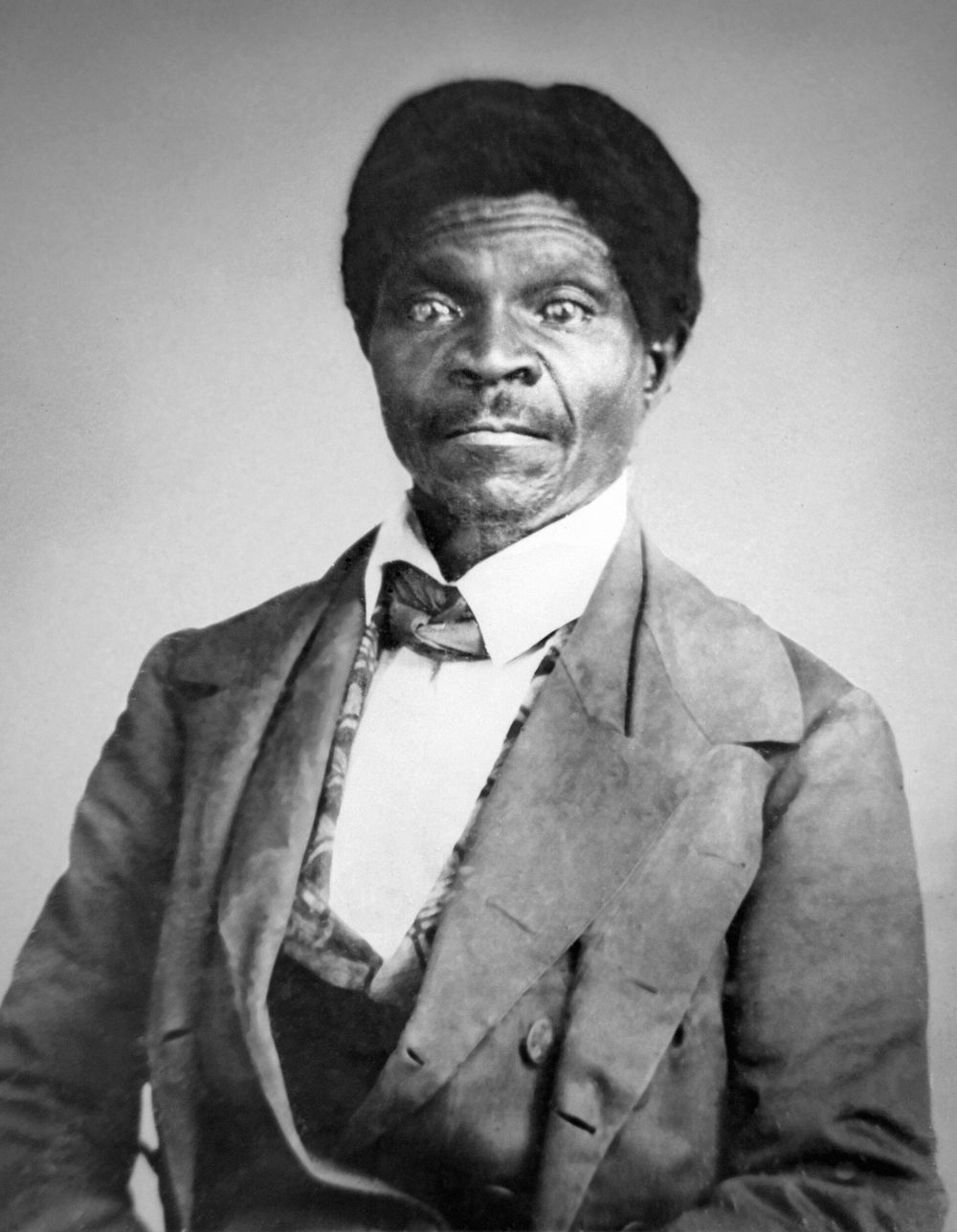
Dred Scott, held as a slave in Missouri, sued for his freedom on the ground that his owner had taken him to live in Illinois, a free state, and in federal territory north of the Missouri Compromise line, where slavery was prohibited. The case reached the Supreme Court on a writ of error from the Circuit Court for the District of Missouri.
The question. Whether a person of African descent whose ancestors were imported as slaves could be a citizen entitled to sue in federal court, and whether Congress could prohibit slavery in the territories.
The holding, with pinpoint pages
Persons of African descent whose ancestors were brought to this country and sold as slaves "are not included, and were not intended to be included, under the word 'citizens' in the Constitution." The federal courts therefore had no jurisdiction of Scott's suit.
The Missouri Compromise's prohibition of slavery in the northern territory "is not warranted by the Constitution, and is therefore void," and Scott's residence there gave him no title to freedom.
Chief Justice Taney delivered the opinion of the Court. Justices McLean and Curtis dissented, each at length; Curtis showed that free Black men had voted in five states at ratification and were therefore citizens of the United States when the Constitution was adopted. Several other Justices wrote separately.
Persons of African descent "had for more than a century before been regarded as beings of an inferior order, and altogether unfit to associate with the white race, either in social or political relations; and so far inferior, that they had no rights which the white man was bound to respect; and that the negro might justly and lawfully be reduced to slavery for his benefit." The Chief Justice was describing, and adopting as the meaning of the Constitution, the opinion he attributed to the founding generation.
Chief Justice Taney, for the Court.
What it decided, and what it did not.
The opinion treats a person as an article of property whose status travels with the owner across state and territorial lines, and it denies that the national government can end that status in land it governs. Both propositions were reversed by war and by amendment within eleven years. The decision is the clearest statement in the United States Reports of what the ownership status looked like when a court accepted it as law.
Later treatment
Its citizenship holding was overridden by the Fourteenth Amendment, section 1, in 1868, and its premise that a person could be property was abolished by the Thirteenth Amendment in 1865. It is cited today as history and as anti-precedent, never as law.
The network reads Dred Scott as the baseline the Thirteenth Amendment was written against: a legal status of property in a person, recognized and enforced by the highest court. The Amendment abolished that status for everyone, then excepted it as a punishment for crime. The question the network puts to every custodial regime is whether the powers of ownership Taney described, use, transfer, disposal, are exercised over convicted people today. Nothing in this reading treats Dred Scott as authority; it is the record of what was abolished.
Bibliographic identity verified against the Library of Congress scan on September 25, 2026. Pins at 407 and the syllabus checked by text extraction; the pins at 404 and 452 are the standard reporter pages and are marked for confirmation against the page images. The Library's catalog labels the term 1856; the decision date is March 6, 1857. Library of Congress scan of the United States Reports, 241 pages, public domain. Corrections: info@abolishslavery.us.