
From amendment to enforcement.
A ban on paper becomes a ban in practice through records: audits, filings, petitions, and rulings. Eight states removed the exception. This page is what happened next, and what the network does about it.
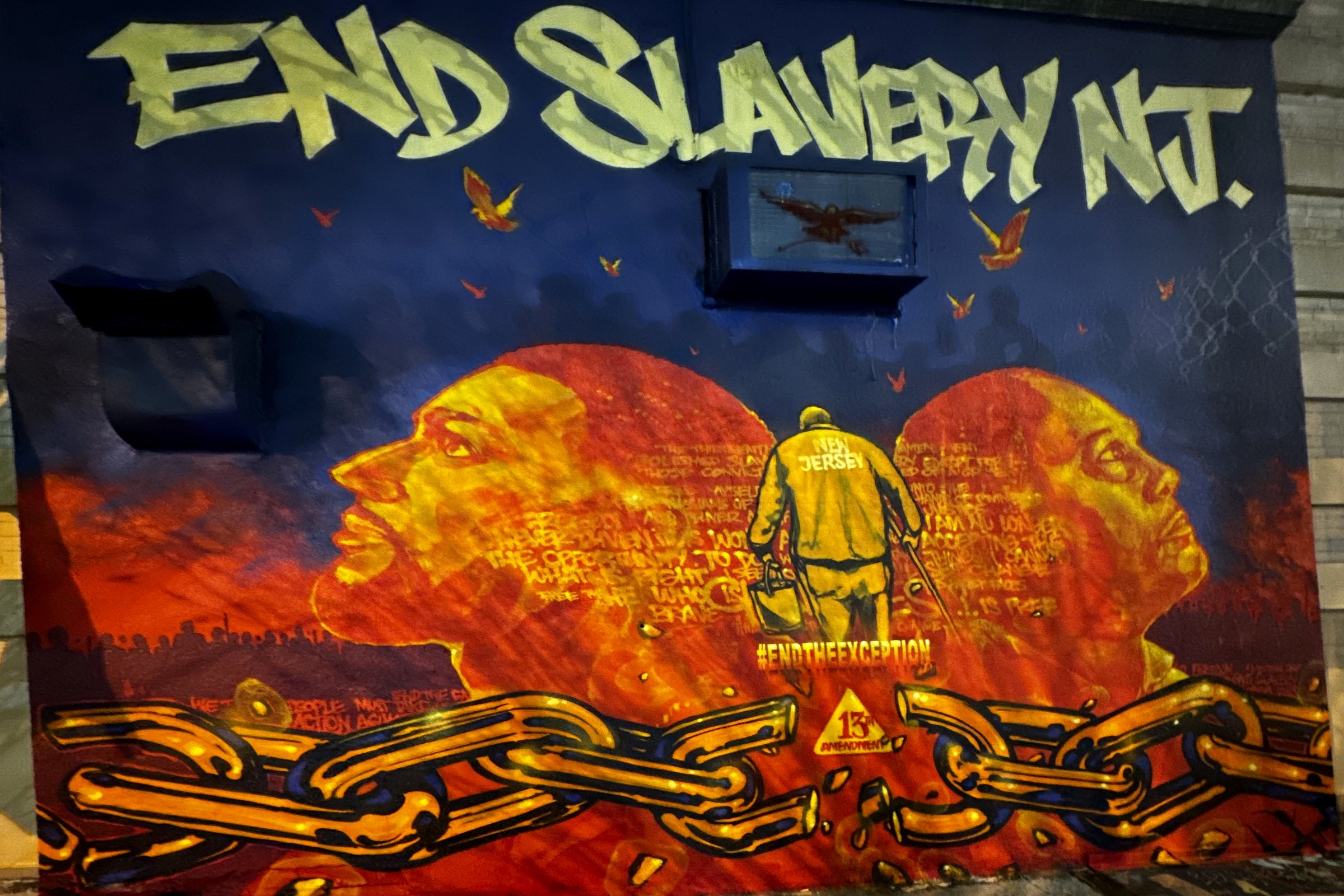
End Slavery in New Jersey. Jersey City, dedicated December 6, 2024. The wall says what the constitution does not yet say. Enforcement is how the wall and the text are made to agree.
MUST ART (Ivan Petro), with Mural Arts Philadelphia, Worth Rises, End Slavery NJ, and the network.What a removal has to contain.
The removals taught the network what a ban has to contain to be enforced.
Colorado struck its exception in 2018 and waited until 2026 for the first order. A bare sentence abolishes nothing a court can enforce.
Alabama and Colorado both pleaded immunity against their own amendments. The waiver goes in the constitution.
The locked door is not the question. What the State does with the person behind it is.
Pay is not a defense. Compensation, in any amount, does not make labor voluntary.
California's Proposition 6 went to the voters under that title in 2024 and lost.
A statute can be repealed in the next budget. Only an amendment reaches the clause.
The rulings.
| Case | Jurisdiction | Citation | What it decided |
|---|---|---|---|
| Mortis v. Polis | Colorado | Denver District Court, Case No. 2022CV30421, February 13, 2026 (Wallace, J.). 61 pages. | Colorado Department of Corrections' coercive labor practices held unconstitutional under the Colorado Constitution, Article II, Section 26, as amended by the voters in 2018. The first ruling to give a removal operational force. Decided as involuntary servitude; the court was never asked to say what slavery means. |
| Stanley v. Ivey | Alabama | Alabama Court of Civil Appeals, CL-2024-0710, December 19, 2025. | Alabama removed its exception in 2022. The State pleaded sovereign immunity against its own amendment, and the appeal lost because the penalties alleged were held not to be involuntary servitude. Why the remedy and the immunity waiver go in the text. |
| Ruelas v. County of Alameda | California | 15 Cal. 5th 968 (2024). | People never convicted worked unpaid for a private contractor in a county jail, sued for minimum wage, and lost unanimously because a statute still stood. What keeps wage law out of jails is statutes, not the exception. A statute is not an amendment. |
Each case name opens the opinion. Every case in the Research Library.
Colorado, after the vote
Source text What the court ordered, in its own words. The Department must "cease threat and use of segregation and isolation" for failure to work, and must stop "double charging" a refusal to work as a second offense "such as 'Disobeying a Lawful Order.'" The order did not reach earned time and did not strike the work requirement. It was stayed twenty-eight days to allow an appeal. The ruling, pages 58 to 60.
Source text Colorado, 2022. Four years after the vote, the legislature struck the words "shall be put to and kept at" work from the statute and replaced them with "shall participate in" work that "promotes the inmate's successful rehabilitation, reentry, and reintegration." It struck "profit-oriented" from Correctional Industries' mandate. The constitutional text did not change the statute. The legislature did. Senate Bill 22-050.
Five lines of attack, each building its own record.
Plea disclosure
No plea form the network has audited tells the defendant that conviction suspends the protection against slavery. New Jersey's petition, filed April 17, 2026, is the model.
Labor and wage claims
Matched filings with the state labor department and the federal Wage and Hour Division. Two agencies answering the same facts leave a record.
Juvenile waivers
Children transferred to adult court inherit the adult status on conviction. The transfer statutes are the target. Children, in full.
Disabled defendants
Where the law already limits what punishment may reach, the exception's reach is limited too.
The remaining ownership powers
Every power the audit finds exercised is a grassroots trigger. Not every fight is in a courtroom.
Is anyone told?
The plea disclosure petition was filed with the New Jersey Supreme Court Criminal Practice Committee on April 17, 2026, by the Coalition to End Slavery NJ and the network. It asks that the plea form tell the defendant what conviction suspends.
Measured on the State's own rules.
The Constitutional Abolition Enforcement Standards measure the ownership powers against the ratified definition. Each instrument reports on its own axis, and the findings are never blended into one number. A score of 1 in any domain triggers grassroots action. A score of 2 or above triggers a litigation referral.
Findings are published for New Jersey and Minnesota. Minnesota's custody finding is provisional.
No conviction, no exception.
The Thirteenth Amendment reads "except as a punishment for crime whereof the party shall have been duly convicted." Immigration detention is civil. So is detention while awaiting trial, and so is civil commitment. No one held that way has been convicted of the thing they are held for. The exception does not reach them at all.
Established holding The Ninth Circuit, 2025, on the people GEO put to work at its Tacoma detention center: "They are civil detainees. They are not in criminal proceedings." Washington's minimum wage law applies to them. Nwauzor v. The GEO Group, Inc., 127 F.4th 750. GEO has asked the Supreme Court to review that ruling, and on September 15, 2026 the United States urged the Court to take the case.
Established holding The Ninth Circuit, 2022, on people held by CoreCivic in California: "detained solely due to their immigration status and neither charged with, nor convicted of, any crime." Three classes certified. Owino v. CoreCivic, Inc. The Eleventh Circuit, 2020: the federal forced labor statute reaches private contractors running detention work programs. Barrientos v. CoreCivic, Inc. The Fourth Circuit, 2021, went the other way on federal wage law. Ndambi v. CoreCivic, Inc.
Established holding The Supreme Court, February 25, 2026: a federal contractor's claim that the government "authorized and directed" its conduct is a defense to be tried, not an immunity from suit. GEO could not stop the Colorado detainees' forced labor and unjust enrichment class action before trial. GEO Group, Inc. v. Menocal, 607 U.S. ___ (2026).
Established holding Ruelas v. County of Alameda, California Supreme Court, 2024. People never convicted worked unpaid for a private contractor in a county jail and lost their wage claim because a statute still stood. What keeps wage law out of jails is statutes, not the exception.
Network position These suits are pleaded as forced labor and unpaid wages. The network reads them on the status axis. In detention there is no exception to plead. Every power of ownership exercised there is exercised with no authorization in the constitution at all. The people awaiting trial in every state's jails stand on the same ground. The fight to end the exception and the fight for people in immigration detention are the same fight, on the same clause.
A child is not "duly convicted."
The exception has one condition: "a punishment for crime whereof the party shall have been duly convicted." Children meet the exception two ways, and the network answers both.
Source text A child adjudicated delinquent has not been convicted. Juvenile court is not criminal court, and the states say so in their own statutes. New Jersey: "No disposition under this act shall operate to impose any of the civil disabilities ordinarily imposed by virtue of a criminal conviction, nor shall a juvenile be deemed a criminal by reason of such disposition." N.J.S.A. 2A:4A-48. A child committed to a juvenile facility stands where a person in immigration detention stands. No conviction, no exception, no authorization for any power of ownership exercised there.
Source text A child transferred to adult court is a different case. On a prosecutor's motion, New Jersey moves a child of 15 or older charged with a listed offense out of juvenile court, and "the case shall proceed as if it originated in that court and shall be subject to the sentencing provisions available to that court." N.J.S.A. 2A:4A-26.1. On conviction the child inherits the adult status, with everything the exception permits. The transfer statute is the target.
Established holding The Supreme Court has held three times that youth is constitutionally distinct. Roper v. Simmons, 2005: "juvenile offenders cannot with reliability be classified among the worst offenders." Graham v. Florida, 2010: "Because juveniles have lessened culpability they are less deserving of the most severe punishments." Miller v. Alabama, 2012: "Roper and Graham establish that children are constitutionally different from adults for purposes of sentencing." Both children in Miller were 14 and had been tried as adults.
Source text The transfer statutes date from the 1990s. A forecast of a coming generation of juvenile "superpredators" moved forty-nine states and the District of Columbia, between 1992 and 1999, to pass laws making it easier to try children as adults. The forecast failed. In 2012 forty-seven scholars, including the man who coined the term, told the Supreme Court in Miller that "the juvenile superpredator was a myth and the predictions of future youth violence were baseless." The statutes remain.
Network position The network reads children on the status axis. In a juvenile facility there is no conviction and so no exception; every power of ownership exercised there is exercised with no authorization in the constitution at all. In adult custody, a child holds the adult status because a transfer statute put it there, on the strength of a forecast its own author has withdrawn. The remedy for the first is enforcement. The remedy for the second is repeal of the transfer statute. Neither waits on an amendment.
The remedy goes in the constitution.
The model amendment carries the definition, the remedy, and the immunity waiver in its own text, so enforcement does not wait on a later statute.
Cite this page. Abolish Slavery National Network, “Enforcement After Removing the Punishment Exception,” https://abolishslavery.us/enforcement.html.