
The powers of ownership, and how a court reads them.
Slavery is "the status or condition of a person over whom any or all of the powers attaching to the right of ownership are exercised." The definition names the powers. International courts have named the signs that show them being exercised. Together they are the test the network applies to every prison regime: not whether the work is hard, but whether the person is held as property.
The instrument measures the Kunarac indicia and proves the Bellagio powers.
CAES, the Ownership Audit Instrument. Kunarac supplies what to look for. Bellagio-Harvard supplies what it proves.
Seven powers. One foundation. One gate.
The Bellagio-Harvard Guidelines on the Legal Parameters of Slavery (2012) explain the 1926 definition. Possession is the foundation (Guideline 3). Use, management, profit, transfer, and disposal are what possession is exercised for (Guideline 4). Security of holding is the gate that separates a harsh regime from an owning one (Guideline 6). Each power is stated as the Guidelines state it, then as it appears in a custodial regime's own rules.
Possession
Control of the person's body and whereabouts. The foundation: without it no other power can be exercised. In custody it is acquired at the judgment of conviction and secured against loss.
Use
Obtaining benefit from the person: their labor or services. In custody: work is mandatory and assigned, and refusal is punished.
Management
Directing and controlling the use: what work, when, where, under what rules and sanctions. In custody: the job assignment, the schedule, the disciplinary code, the classification decision.
Profit
Taking the value the person produces. In custody: goods and services produced for the institution or its contractors, at wages the custodian sets or withholds; liberty itself metered out in exchange for work.
Transfer
Moving the person, or the right to their labor, from one holder to another. In custody: transfer between facilities and states, and contracting of the person's labor to private operators.
Disposal
Treating the person as disposable: mistreatment, neglect, or abandonment without consequence. In custody: conditions the holder can impose because the held person cannot leave.
Security of holding
The holder's protection against losing the person held. The gate: harshness alone is not ownership. A regime that secures its hold on the person, and punishes the loss of it, has crossed from control into possession.
Bellagio-Harvard Guidelines on the Legal Parameters of Slavery, 2012. The Guidelines interpret the treaty; the treaty is the authority.
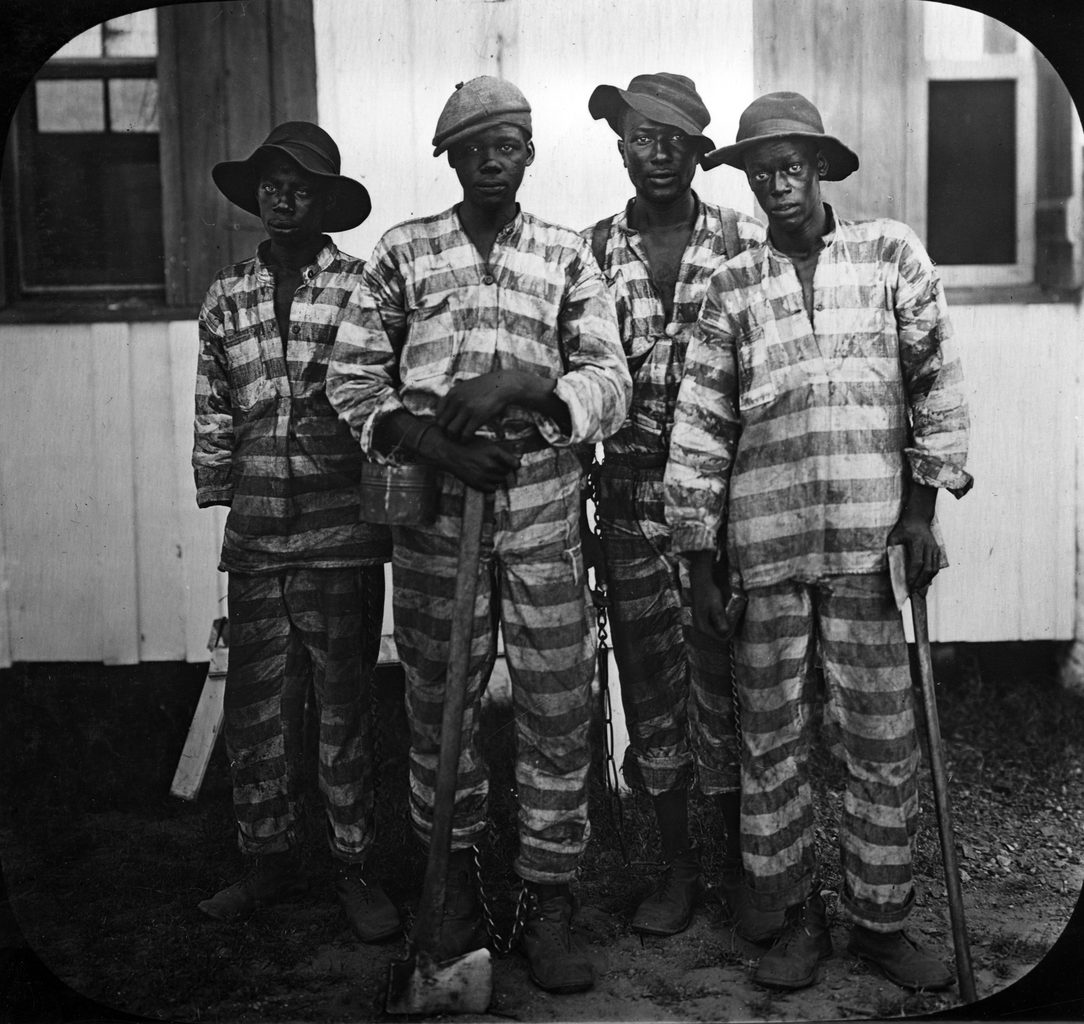
Convicts leased to harvest timber, Florida, 1915. Possession, use, management, profit, transfer: five of the powers in one photograph. The lessee paid the State for the men.
State Archives of Florida. Public domain.The Kunarac indicia.
In Prosecutor v. Kunarac the International Criminal Tribunal for the former Yugoslavia held that the crime of enslavement is "the exercise of any or all of the powers attaching to the right of ownership over a person," and listed the factors that show it. The Appeals Chamber affirmed the list in 2002. It is the only court-validated set of indicators for the ratified definition, and it was written for captives held by a state's armed forces, which is why it fits the prison.
Control of movement
Custody itself: the cell, the count, the pass.
Control of the physical environment
The institution decides the space, the light, the temperature, the company.
Psychological control
Classification, points, privileges granted and withdrawn.
Measures to prevent or deter escape
Walls, counts, escape as a separate crime, the loss of earned time.
Force, threat of force, or coercion
The disciplinary code and the use-of-force policy.
Duration
The sentence, and the supervision that follows it.
Assertion of exclusivity
No other holder: the State alone decides where the person is and what they do.
Subjection to cruel treatment and abuse
Conditions the held person cannot leave.
Control of sexuality
Visitation, contact, and the regulation of intimacy.
Forced labour
One indicium among ten. Not the test. Part of the evidence.
Prosecutor v. Kunarac, Kovac and Vukovic, IT-96-23-T and IT-96-23/1-T, Judgement (ICTY Trial Chamber, 22 February 2001), paras. 539 to 543; affirmed, IT-96-23 and IT-96-23/1-A (Appeals Chamber, 12 June 2002), para. 119. Appeals judgement (ICTY). Trial judgement (ICTY).
Forced labour is one indicium among ten. The test is the exercise of ownership powers, and it is detectable wherever those powers are exercised, whatever the local label. A regime that never uses the word slavery can still be measured against it.
"The law does not know of a right of ownership over a person." The finding is always about powers exercised, never a declaration that a state holds title. That is why the audits read the regime's own regulations, domain by domain, and score what they authorize.
Kunarac, Appeals Chamber, para. 118.
The Ownership Audit Instrument scores seven domains of a custodial regime, each a cluster of these powers restated as institutional practice: movement, discipline and force, bodily autonomy, labor and services, property and earnings, communication and association, and release. The badges and incidents, the population axis. The instrument, CAES. The treatise, The White Pages.
Cite this page. Abolish Slavery National Network, “The Powers of Ownership and the Indicia of Slavery,” https://abolishslavery.us/powers.html.