
Article I, paragraph 24.
The amendment the network has drafted for the New Jersey Constitution. The language is up front, paragraph by paragraph, with one plain paragraph under each saying what it does. What is built here is built for every state after it.
Slavery and involuntary servitude are prohibited. This prohibition applies in all circumstances, including as punishment for crime, and admits of no exception.
Proposed text, September 2026. Not yet introduced. The earlier concurrent resolutions, SCR 16 and SR 91, are the companions in the current session.
Seven paragraphs. Each with a job.
(a) says what slavery is. (b) says what forced work is. (c) says what a real choice is. (d) takes the money out. (e) opens the courthouse. (f) takes away the State's shield. (g) clears the books.
Article I, paragraph 24
24. Slavery and involuntary servitude are prohibited. This prohibition applies in all circumstances, including as punishment for crime, and admits of no exception.
New Jersey's constitution has no ban on slavery today. The only ban in force is the federal Thirteenth Amendment, and that one carries the exception for punishment. This sentence gives New Jersey its own ban and names the one circumstance the federal text leaves open. The words "admits of no exception" are an instruction to the courts. The list of exceptions is closed, and no judge may read a new one in.
(a)For purposes of this paragraph, slavery is the status or condition of a person over whom the State, a subdivision, or any other person or entity exercises, in whole or in part, the powers attaching to the right of ownership. The exercise of such powers includes, without limitation: using a person; managing the use of a person; profiting from the use of a person; appropriating the fruits or products of a person's labor; or transferring, disposing of, or degrading a person by treating them as an object of ownership. Any one of these is sufficient to constitute slavery where it is exercised over a person under control tantamount to possession, and confinement is such control. Legal title and total dominion over the person are not required; it is sufficient that a power attaching to the right of ownership is exercised over the person in fact. It makes no difference whether a power is exercised for public or private benefit, or whether the labor produces goods for sale or maintains the institution. No proof of intent or motive is required. Custody under law, standing alone, is not slavery. Custody confers the power to confine a person. It confers no power to use a person, manage or profit from that use, or take what the person's labor produces, and the compelled labor of a confined person is not an incident of custody. Neither custody nor a judgment of conviction precludes slavery where a power attaching to the right of ownership is exercised over the person, whether by means of the control that custody secures or otherwise.
This paragraph says slavery is a status, and it tells a court how to recognize it. A person is held in slavery when someone exercises an owner's powers over them: using them, managing that use, profiting from it, taking what they produce, or moving and disposing of them like a thing. The definition is the one the United States accepted by treaty in 1929, and it names the State as someone who can do this. Any one power is enough when the person is under control equal to possession, and the text says outright that confinement is that control. Nobody has to hold a title to the person. It does not matter whether the State or a company benefits, or whether the work is the shop or the kitchen. Nobody has to prove what the State was thinking or why; the question is what it did. The custody sentences draw the line the whole amendment stands on. The State may hold a person. Holding a person gives it no power to use that person, and compelled labor is not part of being confined. Custody alone is not slavery, so no court can say the amendment abolishes prison and throw it out.
(b)Involuntary servitude is the condition in which a person is compelled to labor or render service by force, threat of force, physical restraint, abuse or threatened abuse of legal process, fraud, deception, or any scheme, plan, or pattern intended to cause the person to believe that nonperformance would result in serious harm or restraint of liberty. Serious harm means any harm, whether physical or nonphysical, including financial harm and the deprivation of a basic human need, that is sufficiently serious, under all the circumstances of confinement, to compel a reasonable person in the same circumstances to perform or continue labor or service to avoid it. The definitions in this paragraph are independent of one another. No element of involuntary servitude shall be required to establish slavery under subparagraph (a).
This paragraph covers the second wrong, being made to work. It reaches force and threats, but also the abuse of legal process, fraud, and any scheme that makes a person believe serious harm will follow if they stop. The federal courts have read servitude narrowly, as physical or legal force only. This text uses the wider standard and defines serious harm to include nonphysical harm, financial harm, and the loss of a basic need, judged by what would move a reasonable person in that cell. The last two sentences keep the two wrongs apart. Nobody has to prove servitude in order to prove slavery. A person who never worked a day can still be held in slavery.
(c)Nothing in this paragraph prohibits the voluntary labor of a confined person. Labor is voluntary only if the person gives informed consent and retains the unimpeded right to refuse or cease it without penalty or loss of any right, privilege, benefit, opportunity, favorable classification, or condition of confinement, and the labor is performed under safe conditions. The loss, denial, or delay of any credit, reduction of sentence, release opportunity, or benefit conditioned upon the performance of labor constitutes a penalty for purposes of this subparagraph. Compensation, in any amount, does not establish that labor is voluntary or that no power attaching to the right of ownership was exercised. Labor or service performed for the State, a subdivision, or any other person or entity that is not voluntary under this subparagraph is prohibited by this paragraph, and the State, subdivision, person, or entity bears the burden of proving by clear and convincing evidence, without deference to the judgment of correctional officials, that each requirement of this subparagraph was satisfied. Labor that is voluntary under this subparagraph is not, by reason of the labor alone, the exercise of a power under subparagraph (a). A violation of this subparagraph requires no proof under subparagraph (a) or (b), and nothing in this subparagraph limits either.
Work stays. What ends is assignment. This paragraph says work is lawful when it is truly chosen, and it defines chosen: informed consent, the right to refuse or quit with no penalty of any kind, and safe conditions. Then it closes the State's three answers. If a credit, a sentence reduction, or a release opportunity is lost or delayed because a person did not work, that is a penalty, so the State cannot say the person chose the work for the time. Pay in any amount does not make work voluntary, so a wage cannot turn compelled work into a job. And the burden is on the State to prove the work was voluntary, by clear and convincing evidence, with no deference to correctional officials. The confined person does not have to prove they were forced. Voluntary work is not slavery merely because it is work.
(d)No contract, agreement, or arrangement shall condition any payment, occupancy, or benefit upon the maintenance of a minimum number of confined persons or upon the availability of their labor.
This paragraph takes the money out. No contract may pay by keeping a minimum number of people confined, and none may pay by having their labor available. Occupancy guarantees and labor-supply terms are how an interest in keeping people becomes a line in a contract. The paragraph ends that, for the State and for anyone who contracts with it.
(e)This paragraph is self-executing and enforceable in the courts of this State whether or not the Legislature has acted to implement it. Any person subjected to a violation of this paragraph may bring a civil action and may obtain injunctive, declaratory, and monetary relief, including damages, restitution and disgorgement of any financial benefit derived from the violation, and reasonable attorney's fees and costs. The action is an original action in a trial division of the Superior Court. No administrative remedy need be exhausted before it is brought, and the availability of review of agency action does not bar or delay it. To be held in slavery is an injury in itself, and a claim under subparagraph (a) carries its own remedy. A person held in slavery is entitled to a judgment declaring that status, binding on the State, and to compensatory damages for the status itself, without proof of labor, loss, or compulsion, in addition to any other relief. Because relief under subparagraph (b) or (c) does not supply that remedy, a claim under subparagraph (a) is not rendered moot, unnecessary, or subject to discretionary refusal by relief available or awarded under those subparagraphs, and a person who brings such a claim may obtain a judgment determining whether the person was held in slavery. This remedy is in addition to any other remedy available at law or in equity.
This paragraph opens the courthouse. The ban works on its own; the Legislature does not have to pass anything first. Any person subjected to a violation may sue for a court order, a declaration, money damages, the return of whatever the State gained, and attorney's fees. The case starts in the trial court as an original action. No grievance has to be finished first, and the existence of agency review does not block or slow it. Then comes the status remedy. To be held in slavery is an injury in itself. A person held in slavery is entitled to a judgment saying so, binding on the State, and to damages for the status, with no proof of labor or loss. The last long sentence stops a court from granting smaller relief under (b) or (c) and then declining to rule on slavery. The person is entitled to the answer.
(f)Sovereign immunity shall not bar any action arising under this paragraph. No remedy may be denied on the ground of the immunity of the State, its counties, municipalities, or their agencies, officers, or employees. This subparagraph applies to qualified and good-faith immunity as well as sovereign immunity, and no notice requirement, limitation on liability, or restriction on remedies under Title 59 of the New Jersey Statutes or any successor law shall bar, limit, or delay an action or remedy under this paragraph.
Without this paragraph the ban has no remedy. Alabama struck its exception in 2022, and the first suit was dismissed on sovereign immunity before any judge looked at the facts. This paragraph says the State, its counties, its towns, and their agencies, officers, and employees cannot claim immunity in these cases. It reaches qualified and good-faith immunity as well, and it sets aside the Tort Claims Act's notice deadlines and damage limits for these actions. New Jersey's immunity is a policy choice made by courts and the Legislature. It is not in the constitution, so a sentence in the constitution overrides it.
(g)Any law, regulation, or practice inconsistent with this paragraph is void to the extent of the conflict.
This paragraph clears the books on the first day. The mandatory-assignment statute, the work regulation, and the refusal charges as applied to labor stop having force to the extent they compel labor. No separate repeal campaign is needed, and no agency can say it is waiting for the Legislature to act.
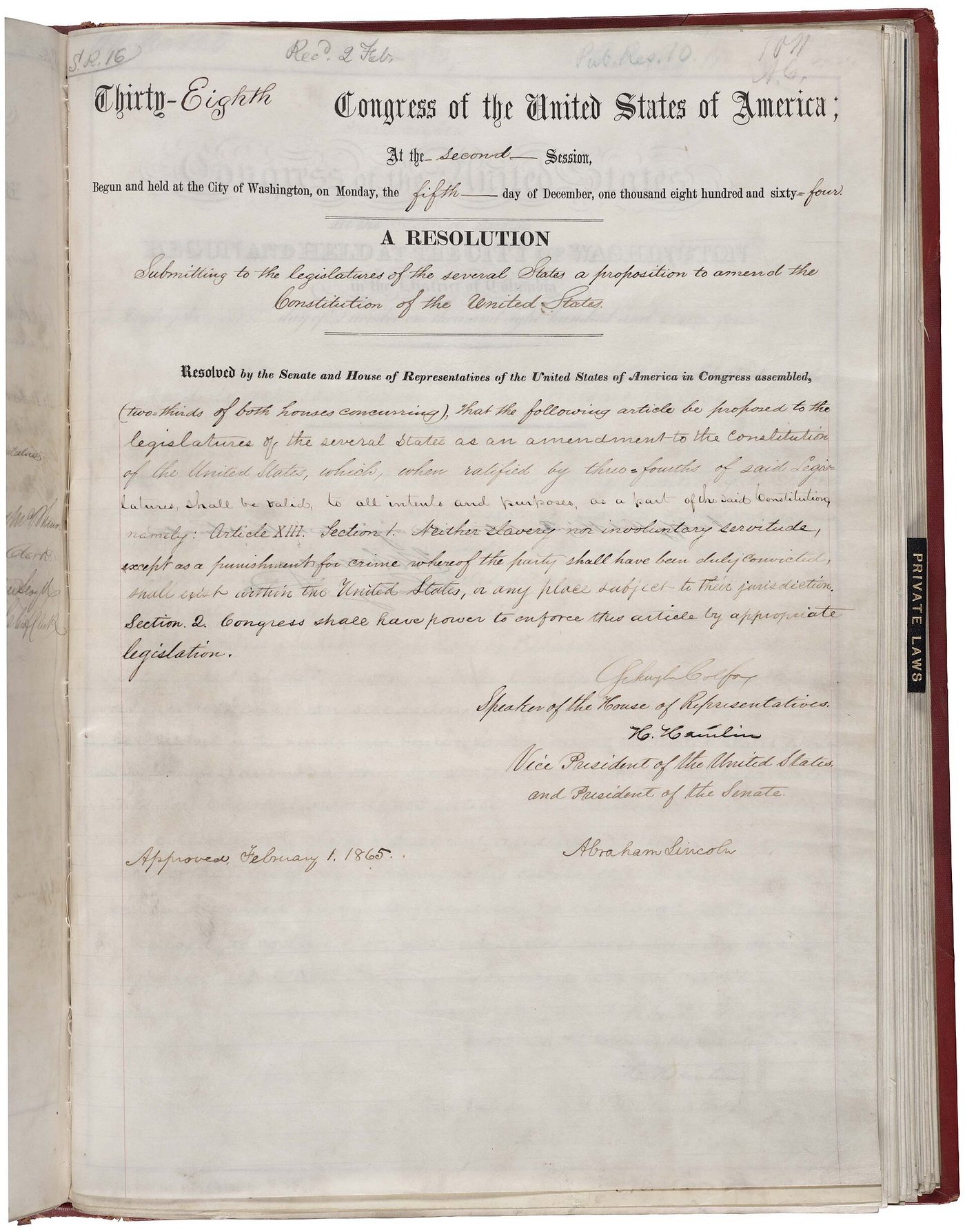
The joint resolution proposing the Thirteenth Amendment, 1865. One sentence, one exception. Every state text on this site descends from it. The bill above writes the sentence without the exception.
National Archives. Public domain.The question the voter answers.
Public question
Do you approve amending the Constitution to prohibit slavery and involuntary servitude in all circumstances, including as punishment for crime, without exception?
Adds this protection to the Constitution.
Leaves the Constitution unchanged.
It is one sentence, and it asks about a status. It does not mention work, wages, or prison jobs, so a voter cannot answer it by comparing a confined person's work to their own. The question is whether New Jersey permits slavery, and the answer it invites is no.
This amendment bans slavery and involuntary servitude in New Jersey in every circumstance, including as punishment for a crime. The State Constitution has no such ban today. The amendment defines slavery as the United States has by treaty since 1929: exercising over a person the powers of an owner, whether or not anyone claims to own that person. The State may still confine a person convicted of a crime. It may not use that person as property, take what that person produces, or punish that person for refusing to be used. A person in custody may still choose to work. A person held in slavery may go to court for a judgment and damages, the State may not claim immunity, and laws and rules that conflict with the ban no longer apply. A "YES" vote adds this protection. A "NO" vote leaves the Constitution unchanged.
New Jersey courts can strike a ballot statement that hides what an amendment does. This one says what stays, what ends, and how the ban is enforced, in the language of status from beginning to end.
What the drafting record taught.
The removal states showed what a bare sentence cannot do. Colorado struck its exception in 2018 and won its first order in 2026, with no damages. Alabama got immunity pleaded against its own amendment. So this text carries its definition, so a court has something to apply; its rule that pay does not make labor voluntary; its self-executing remedy, so the status is its own injury; and its immunity waiver, in the constitution, where a statute cannot reach it.
It sets no wage and makes no person an employee. Compensation and workplace protections for confined persons are separate legislation, which may govern only labor that is voluntary under (c). Labor that is not voluntary is prohibited, not regulated. The twelve statements carry the authorities.
Ask your legislators to sponsor it as submitted.
The Coalition to End Slavery NJ carries the state campaign.