
On the Legality of Slavery and Involuntary Servitude in the United States of America
A constitutional treatise. Dennis Febo. Coming soon. The treatise is currently in development and review and has not been released. Its subject is one sentence of the Constitution: ratified in 1865, amended never, administered every day since. Its method is documentary: ratified treaties, enrolled constitutional texts, session laws, read opinions, the regulations of custodial institutions, verified line by line and cited where anyone can check them.
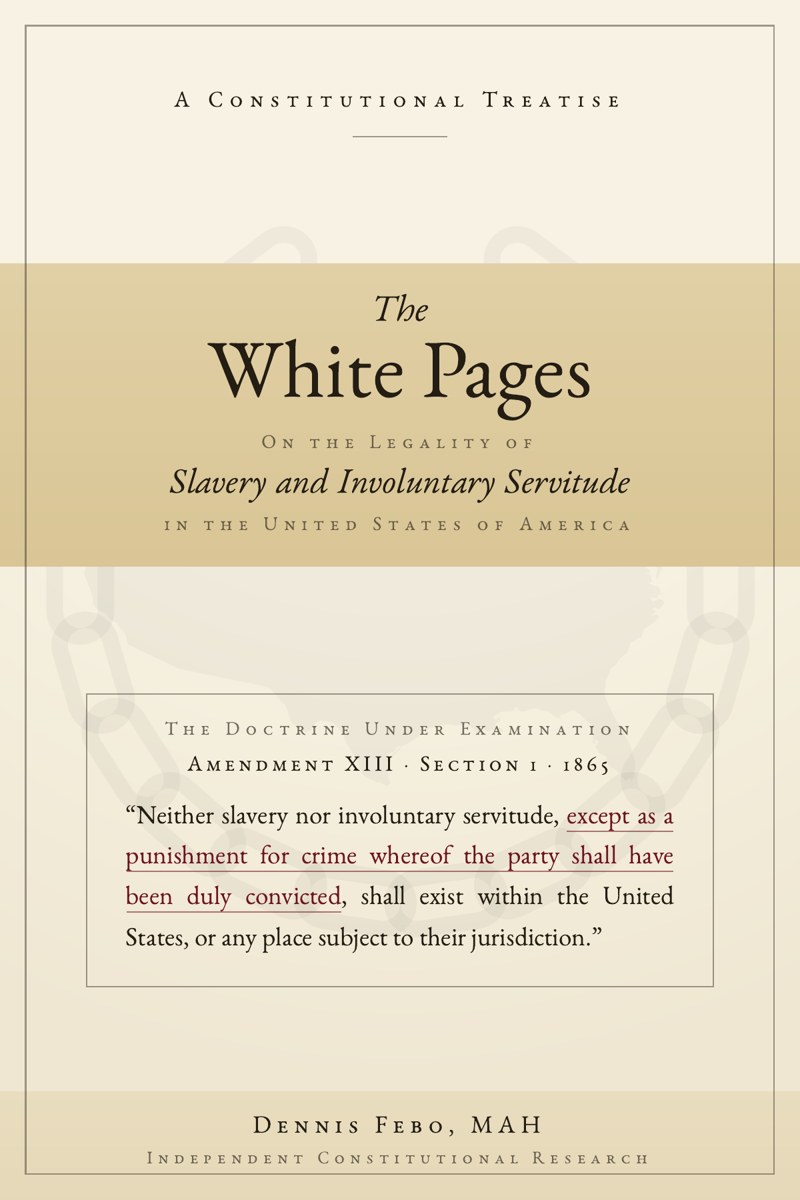
"Neither slavery nor involuntary servitude, except as a punishment for crime whereof the party shall have been duly convicted, shall exist within the United States, or any place subject to their jurisdiction."
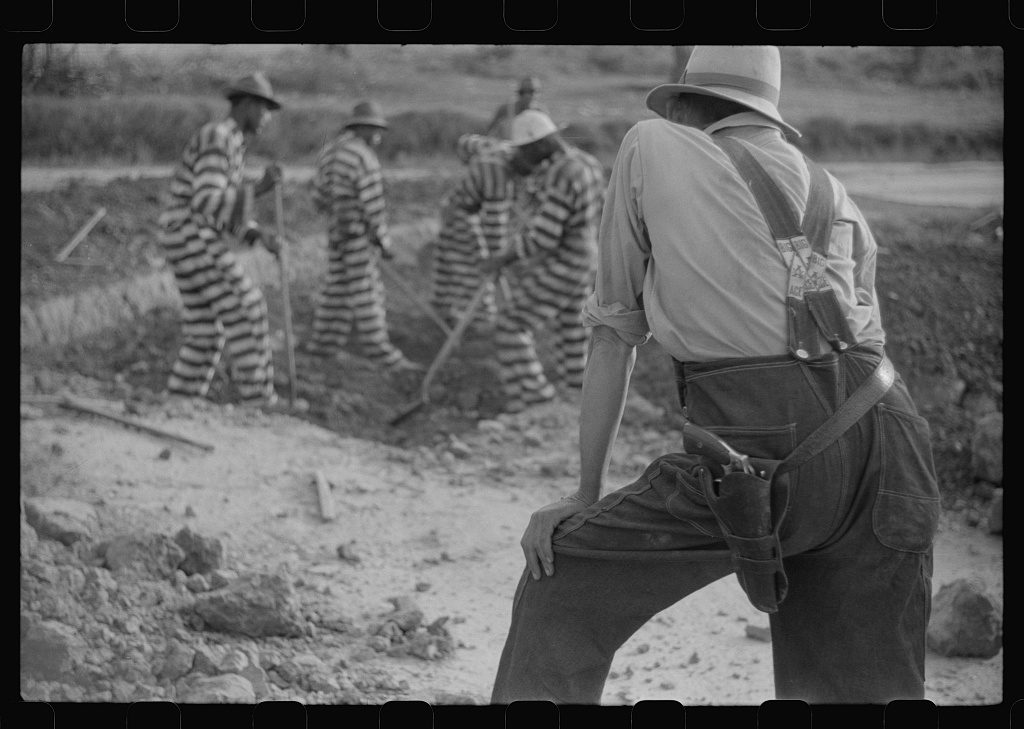
Convicts and guard, Oglethorpe County, Georgia, May 1941. Seventy-six years after ratification. The treatise traces the status from this field to the present regulation.
Jack Delano, Farm Security Administration. Library of Congress. Public domain.One question. One finding. One proposition.
The record is organized around them. They are stated once, exactly, and every part of the book serves them.
Under the punishment exception, criminal conviction creates a legal status of servitude. Does conviction also authorize the State to exercise powers of ownership over the person, and if not, by what instrument is that exercise measured?
The punishment exception suspends the protection against two legal statuses. Positive law enacts only one: servitude, labor compelled by legal coercion. The other, slavery, has been administered as a claim of ownership over the convicted person. That claim has never been adjudicated, measured, or constrained.
The ownership status is measurable, and measurement is the precondition of its abolition. CAES, the Constitutional Abolition Enforcement Standards, is the instrument that measures it and grounds the constraint.
First, the book never concedes that the exception authorizes what it has been administered to produce. The exception suspends the protection against both statuses. Suspension is not conveyance. No positive law converts the suspension into title, and the ratified definition bars the conversion. What a regime exercises in the opening is exercised, never authorized. Second, the book pleads only what its record carries. It does not claim that American courts always favor power; they freed the peon and convicted the private master. It claims what the cases show: where the State itself is the master, the ownership question has never once been asked. A question never asked is not an answer.
Slavery as a legal structure, not a historical metaphor.
American public language treats slavery as a historical event with a moral afterlife: a thing that ended in 1865, invoked since as metaphor, comparison, and accusation. American law knows better. Slavery, in the law the United States has ratified, is not a period of history. It is a status in law. A definition of that kind does not expire with an era. It is a test, applicable to any regime, in any year, that holds persons. This book applies it.
The scope is bounded four ways. To the legal structure: texts, doctrines, institutions, and measurable practices, not a general history or a prison ethnography. To the narrow claim: the book claims what its record proves and marks its argued positions as argued. Against its companions: the deepest single-jurisdiction records and the campaign strategy are standalone volumes. By verification: every case quotation was verified against the read opinion before it was used, and every citation not yet pinned carries its flag in place.
The next court handed the question, the next legislature drafting the referendum, and the next advocate standing at the plea-side silence will hold what none of their predecessors held: the definition in one hand, the measurement in the other, and a record connecting them.
Eight parts. Never named, never measured, never constrained.
Part I names the status. Parts II and III show its formation and its industrialization. Part IV shows the courts declining, in exactly one direction, to look at it. Part V maps where its enabling clause stands today. Part VI builds the instrument that measures it. Part VIII opens the strategy that constrains it.
The definition
What slavery legally is: the status of a person over whom the powers of ownership are exercised, binding United States treaty law since 1929, not self-executing in United States courts, carrying definitional weight rather than a cause of action. Status and condition. Involuntary servitude on the labor axis. The Bellagio-Harvard Guidelines. There shall be no property in man. The status after sentencing.
Formation of the status
One clause, five frontiers: the exception traveled with the flag. The genealogy of the clause, every wording from 1784 to the present. Slavery in United States lands. The 3/5ths compromise, Indians not taxed, the exception before 1865, the Thirteenth Amendment compromise, the Freedmen's Bureau, the Black Codes.
Transformation and carceral construction
The history of Anglo punishment in law. The tread-mill. Slavery by another nomenclature. Jumping Jim Crow. The psychology of escape. Human stock and bonds. Convict leasing, the chain gang, and the industrial regime.
Judicial recognition, in one direction
Dred Scott to Mortis. The Civil Rights Act of 1866. Ruffin: the slave of the State. Slaughter-House, Plessy, the Insular Cases. Clyatt and Bailey: the definition enforced against the private master. Jones v. Mayer: the ownership axis pointed away from the prison. Kozminski: the wall against the incarcerated. The plea bargain as the gate in volume. Silence in the courtroom. Mortis v. Polis: the turning point and the measurement gap.
The present legal landscape
The slavery quadrant. The state of the union. Jurisdictions with constitutional legality, jurisdictions with no mention, the powerless territories, the constitutional referendum, and the jurisdictions with ongoing abolition movements.
The instrument
Introduction to CAES. The measurand: Bellagio-Harvard and Kunarac operationalized. The OAI and its gate. The TSI and TSI-D, the collective axis. The BIAI, the badges doctrine operationalized.
The demonstration
Six jurisdictions, scored.
The strategy
The strategy architecture and the action pathways. The campaign itself is a standalone volume.
Stated in the book, left open on purpose.
The purpose and design of punishment in a post-abolition system
Voluntariness, labor, and human dignity in custodial settings
Legal status after conviction in an abolition framework
Due process and informed consent in a high-plea system
Supervision, release, and the continuum of state authority
The measuring rod, the powers of ownership and the Kunarac indicia, has a page of its own, and so do the badges and incidents. The Puerto Rico record publishes as a standalone companion. The operational strategy publishes as a standalone volume. Each is checkable on its own terms; none borrows conclusions the others have not proved. The Puerto Rico record. Publications.
The White Pages and the CAES methodology, including the instrument suite, are the work of Dennis Febo, sole author, who holds title personally. The work is licensed to ASNN Foundation Inc. and the ASNN Action Committee. No entity owns or holds title. Coming soon in English; a standalone Spanish edition is planned. Until release, the record on this site is the public statement of the work.